

With Microsoft being one of the most used technology providers across multiple industries, it’s a no-brainer to take a look at the technology solutions provided by Microsoft, and how you can help companies maximise the potential of these solutions.
To get ahead in your career and stand out from the competition, you can consider earning Microsoft Certifications that will give you more credibility in the IT sector.
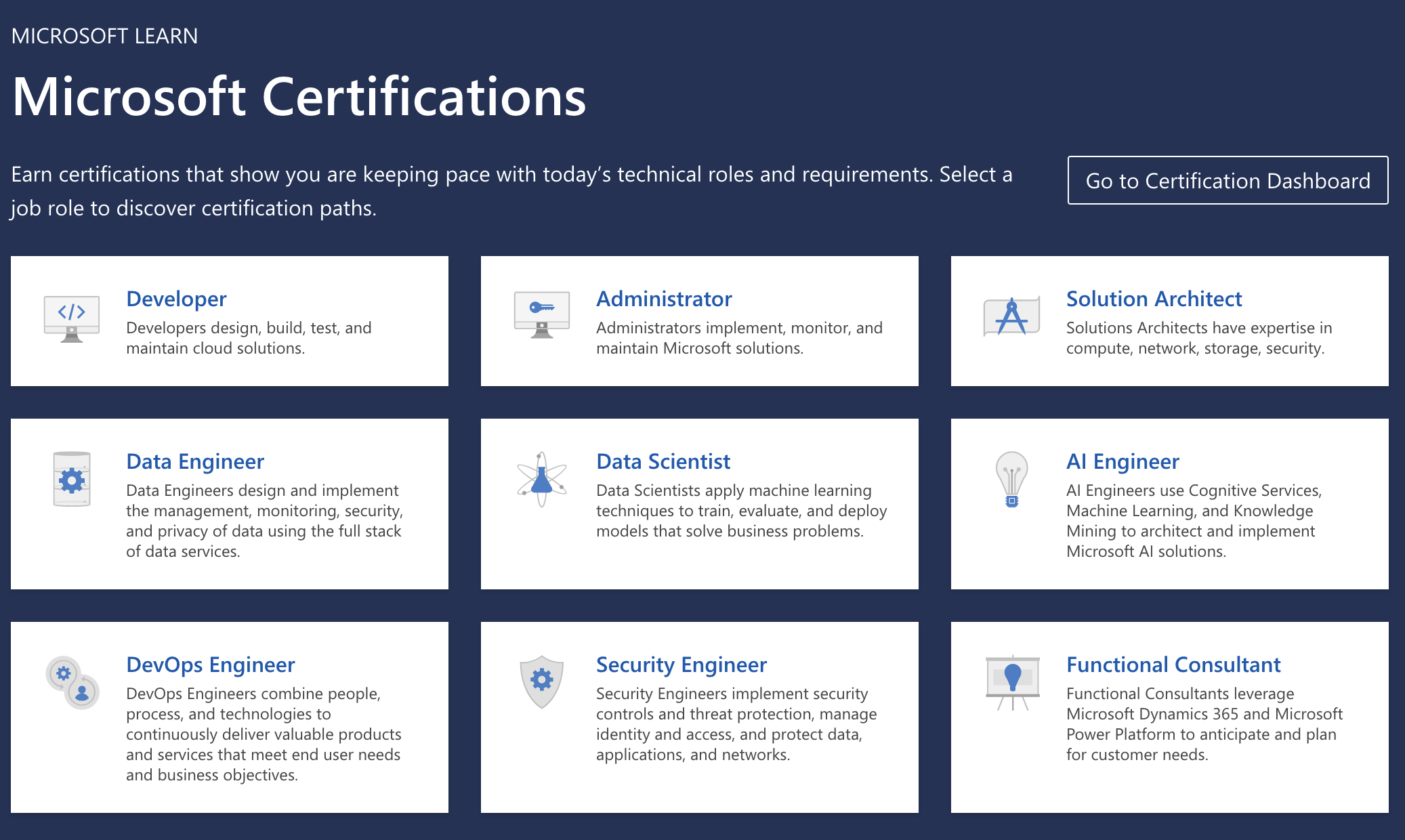
Microsoft’s certification has changed over the past few years, from being connected to specific products to aligning it with common job roles. Microsoft certification is a process of testing IT professionals knowledge and experience in specific set skills. This certification can be obtained in a variety of ways such as through self-study, vendor training and online courses.
According to the survey done by Pearson VUE, earning certifications makes one more credible, more valuable, and more sought after as a candidate. The enhanced skill set developed by obtaining Microsoft Certification can put you on the radar of organisations that rely heavily on Microsoft technology. Simply put, you’ll be in a better position to get your dream role!
There are five primary technologies for which Microsoft certifications are classified. These are:
Next, there are three different kinds of certifications that you may pursue for each of these technologies:
Whatever way you look at it, the Fundamentals certification can help you launch a successful profession. If your goal is to pursue a career in computing, the fundamental abilities are essential. There are nine primary fundamental certifications:

Microsoft is now providing role-based solutions that link IT education to IT department roles. This has two major advantages for businesses and you as an individual.
First, it provides a slew of new employees for the sector, who have been trained using the most recent technology in areas where it’s required.
Second, it allows employees to quickly obtain the skills and platforms that are aligned with real job openings rather than spending months learning things that may or may not be applicable.
The role-based certifications validate the technical skills you would need in one of nine different job roles. They correspond to three different levels of experience, beginning with beginner, intermediate or expert. Individual can also further enhance their technical knowledge by obtaining a speciality certification in line with their job-role/employment function.
Administrators implement, monitor and maintain Microsoft Solutions. This certification path has three levels: Fundamental, associate, and expert. Types of sought after certificates include:
Microsoft AI engineers use cognitive services, machine learning and knowledge mining to develop new applications. This certification path has three levels: Fundamental, associate and expert. The certificate is:

Data engineers are in charge of designing data services and ensuring that they protect the privacy of our data. This certification path has fundamental, associate and expert levels. Certificate is:
Data scientists always consider the business problem they are trying to solve and use machine-learning techniques in order to create, evaluate, and optimise models. This certification path has fundamental, associate and expert levels. Certificate are:
Developers are in charge of design, build, test and maintain solutions. The certification level ranges from fundamental to expert. Types of sought after certificates include:
A DevOps engineer is someone who combines people, processes and technologies into a product or service that meets the needs of both end users and managers. There are three certification levels: Fundamental, associate and expert. The certificate is:
Functional consultants leverage Microsoft Dynamics 365 and Power Platform to anticipate needs of customers. They can take the fundamental, associate, or expert level certification exam. Types of sought after certificates include:
An IT Security Professional is responsible for following the best security practices to protect both the interior and exterior of an organisation or company. Types of sought after certificates include:
Solutions architects are experts in four areas of IT, namely compute, network, storage, and security. Types of sought after certificates include:

Before attempting the specialty certification, it’s strongly advisable that you obtain an Associate or Expert certification. There are just three specialty certifications available:
The cost per exam for the Associate and Expert levels of Microsoft certification is $165.
Microsoft partners with multiple exam delivery providers in different regions to administer its certification exams for candidates of different region. Here are the key considerations:
The good news about getting certified through self-study is that you don’t need any previous experience with programming languages because it can be learned as you go. The downside is that this can take a really long time and it will cost more in the end if you don’t already have any experience with programming languages or digital design.
Certification through vendor training means that someone else is going to teach you everything about Microsoft certification, from the basics to advanced areas of study). This option may be good for people who want guidance on how they should learn these skills but do not know where to start. It also has the advantage of being flexible so changes are made based on your individual needs which makes it easier for some people.
The final way to get certified by Microsoft is online courses; however there are some disadvantages to this option. For one, it will be less expensive than the other two options but you may not have access to a tutor so it’s more difficult in terms of finding help when needed. It also means that you won’t learn from someone who knows what they are talking about and can offer advice on how to actually become certified by Microsoft.
Microsoft Certification is the way to go if you want to be successful in any field related to Microsoft. It helps you get your foot through the door and into a new industry that you could have been interested in. This certification will get you started on the right foot and will provide all of the skills that are necessary for a successful career.

You’ve graduated and you’re finally ready to start your career. Congratulations! You have many options available to you, so how do you know which one is best suited for your personality? That’s where these 10 expert recommended career tests come in handy. They’ll help narrow down the different aspects that make up a person’s ideal job, and give you an idea of what careers are the most suitable for who you are.
One of the most important aspects that make up a person’s ideal job is their specific personality. Personality, at its simplest definition, can be boiled down into four categories: Extroverted vs. introverted personalities; sensing vs. intuitive personalities; thinking mindsets vs. feeling mindsets; and judging vs. perceiving viewpoints.
Personality type may not seem like an aspect that makes up your perfect career, but people really enjoy doing things they’re good at. The more you explore careers which align with your strengths and weaknesses in these areas, the better idea you’ll have about what kind of work suits you best. As you explore different career paths, you’ll be able to narrow down your options by having a better sense of the type of work that suits you best.
There are many ways to get detailed information about your strengths and weaknesses in these four categories, but one easy way is through “personality” testing sites like ‘What’s Your Personality Type?‘ The site has an online assessment which will give you more insight into who you really are as a person, and what types of careers might suit your strengths and weaknesses most.
The infographic below shows how different personality traits can combine with career paths to create various combinations that could be perfect for someone looking for their ideal job.
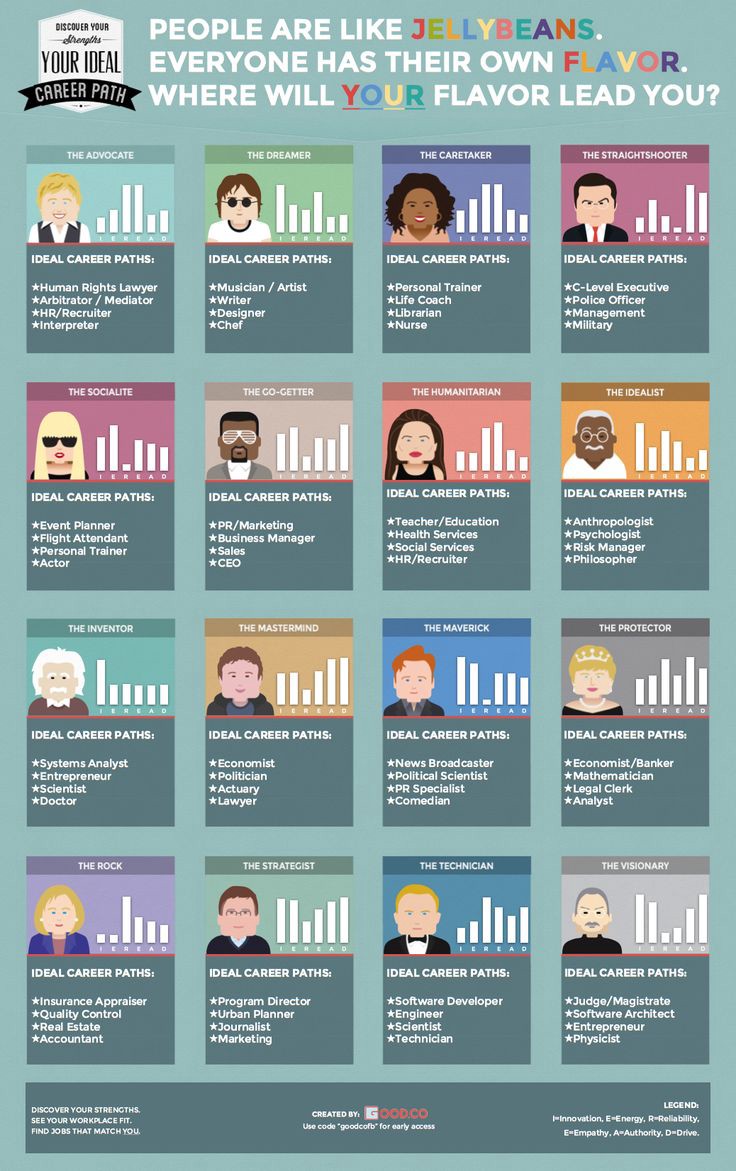
The best way to find what type of work is most suited for you is by exploring careers which match up closely with your strengths and weaknesses in these four areas (extroversion vs. introversion; sensing vs intuition; thinking mindset vs feeling mindset; and judging vs. perceiving) – so take a personality test today!
Once you have a rough idea of your personality, you can delve deeper into career tests to best measure interests and find jobs that are in sync with your skills and ambition. We’ve compiled 10 of the best career aptitude tests you can take online for free and a fee to get in-depth analysis, so you don’t waste time applying for jobs that wouldn’t be a good fit.
It’s important to find a career that suits your personality. Jobs can sometimes be taken for money or status, but should ideally offer the chance to let your personality flourish in pursuit of something you love.
123 Career Test is a five-to-ten minute survey to identify your career personality. This website will show you a variety of career paths, and you answer “yes” or “no” in regards to whether that path would be interesting. 123CareerTest is a site that helps determine which occupation best suit your personality types and recommends occupations that you may enjoy.
Cost: Free
In less than 10 minutes, this career personality test will provide more insight into how you interact with others. The online test evaluates how you would react to new developments and situations, your extroversion, self-discipline, and more. Furthermore, it can help you understand how to handle your job and co-workers.
Cost: Free for the basic report; US$19.95 for the full report
Princeton Review’s career quiz is integral in finding out what you would like to do. 123 Career Test shows pictures, but Princeton Review’s test offers phrases such as “I would rather be a tax lawyer” or “I would rather be a newspaper editor”. If you prefer words to images, take this test instead.
The test consists of 24 questions, and at the end, you’ll be assigned a colour based on how your personality type aligns with different possible career categories. While not as comprehensive as some of the other options on this list, these resources are useful if you’re looking for a direction to explore your interests.
Cost: Free
The MAPP (Motivational Appraisal Personal Potential) test will help determine your true calling by analysing which tasks you enjoy most, how you like to work with people just as much as data and things, and how you reason. Various packages are available for more in-depth results but the free sample offers a basic look at the top two trait preferences and suggests ten possible career paths.
Cost: Free sample; US$89.95 for the full results
Finding a perfect company match with your values can be difficult because you never know what they are or haven’t had experience in that type of environment. MyPlan.com offers a free values assessment that can help you choose your best jobs. The tests assigns an individual to one of six clusters. From there, you are shown a list of 739 occupations that match your assigned cluster best. If you’re unsure about what industry to pursue, this quiz can offer some useful insights.
Cost: Free Career Value Assessment; US$19.95 for the whole package
This test is the best way to discover what your ideal career is according to one of nine personality types: The reformer, the helper, the achiever, the individualist, the investigator, the loyalist, the enthusiast, the challenger, and the peacemaker. This will create a detailed profile that highlights strengths and weaknesses of nine types in your overall personality.
Understanding the type of personality you possess can not only help you relate better to your co-workers, but also clue you in on which characteristics are necessary for a fulfilling career and the challenges that may come as a result with it.
Cost: US$12
Navigating your career can be a difficult task, and it is hard to know what you are good at or which jobs will make you happiest. Some people find themselves wondering if they are on track in their field or if they should explore another opportunity.
The Johnson O’Connor Research Foundation has developed this career strengths tests based on skills such as numerical reasoning and concept organisation. The Career Strengths test, which Oprah herself endorses, is a collection of assessments that evaluates your strengths in these skills. The test can simplify your career search by narrowing down which of the many jobs to pursue.
Cost: Free
This career test, created by the US Department of Labor, is a tool that seeks to offer personalised job suggestions based on an individual’s interests and level of work experience. This 60-question quiz will allow you to learn about six professional areas: Realistic, investigative, artistic, social, enterprising, and conventional.
It comes with a detailed explanation for each area along with several career options, thus helping you to define your interests with explanations on what each career requires. For example, if you were to fall under the ‘realistic’ area, you might like being a driver, and what you’d need is a driver’s license.
Cost: Free
The Myers-Briggs Type Indicator is the most effective way to assess your preferences and suitability for a career you’re considering. MBTI helps individuals understand their strengths and preferred working styles, which ultimately improves their ability to find the right profession.
This assessment can be used in a workplace setting to better understand the strengths and weaknesses of people who work for your company, as well as an individual context to help you understand your own personality traits. Though interests can point to jobs that fit well with certain styles or personality types, they also give insight on what kind of workplaces are best for those scores, as well as how one might interact most comfortably in an office environment.
Cost: US$49.95 for basic online report; US$175 for personal feedback
The test uses the RIASEC theory, which analyse your results to recommend occupations that correspond with each personality type. This career quiz tests how well you fit into each type and shows your top three personality attributes. Those are combined to find a job that matches who you are best. The questionnaire is a brief 20-minute process that asks about your ambitions, and what drives you.
Cost: Starting from US$6.95
The various career tests available to today’s job seekers can seem overwhelming, and many people wonder which test is best for them. Though there are a variety of assessments out there that offer insight into the right occupation or field for you, it helps to know what your personality type is in order to narrow down potential careers.
Use the Myers-Briggs Type Indicator if you want to understand your preferred working style and find occupations that suit those attributes; use PathSource if you need help figuring out where interests should lead; or try the Johnson O’Connor Research Foundation Career Strengths Test if you’re not sure how well certain skills fit with jobs.
Whichever assessment suits your needs better, will provide an overview on which fields might be most fulfilling for you!

Answering challenging interview questions can be tough, but with this guide, you’ll have all the tools you need to ace your strategy and get that job! We’ve compiled a list of the most common interview questions along with tips on how to answer each one.
You’ll find answers that range from basic work history information to more in-depth IQ test questions. Get started now by reading through these helpful tips, and then choose which question you’d like to tackle next!

1) Can you tell me a little about yourself?
This is a classic question that you’ll likely come across in most interviews. What they’re looking for is to see how well you can present yourself and your experiences, so be sure to touch on the highlights of your work history while also showing off some more personal qualities about who you are as a person. You’ll want to include why this position is of interest to you, but try to avoid being too general.
2) Why did you leave your previous employer (or why do you want to leave your present job)?
This question is usually asked to see if there was anything negative behind the reason for leaving. If you were terminated, be honest and explain what happened while also showing that you’re ready to leave it in the past. If you voluntarily left a position then try to focus on things like needing a new challenge, working toward advancement and/or wanting to take on more responsibilities.
3) What are your greatest strengths?
You’ll probably be asked this in almost every interview. The best way to answer this is by coming up with some of your strengths and then pairing them with job-related examples, but remember these should fit the position for which you’re applying. Some examples might be being very organised, having a strong work ethic or working well in fast-paced environments.
4) What are your greatest weaknesses?
This is another often asked question that should have been covered during the research process before going into your interview. Come up with some of your weaker attributes, and then spin them to show how you’re continually working to improve in those areas. For example, you might say that you’re not the best at public speaking but have been taking some courses so that it doesn’t hold your career back.
5) How would a previous employer describe you?
This question has the potential for some really great answers, and impresses hiring managers when they see that you have thought about this question beforehand. Of course, everyone will be able to think of some positive things that have made an impression in their past, so try to come up with a few examples of your work ethic and personality too. For example, you might say that previous employers would describe you as hardworking or someone who’s always willing to go the extra mile for those around them.
6) What are three words you’d use to describe yourself?
This question is a little trickier to answer, but should be approached in the same way as above. Try thinking of three words that you want people to use when they think about your character and personality. Some examples might be positive, hardworking or intelligent. What’s important here is not coming up with negative attributes so try not to choose words like lazy or disorganised.

7) Why do you want to work for this company?
This is a great question that allows the interviewer to get an idea of what your career goals are and how they align with those of the organisation. It also gives them insight into whether or not you are looking at this position as just another job, or if you want to make a career with the company. The best answer is an honest one – telling them how much you love what they do and why that aligns with your own goals can show how well-rounded of a person you are.
8) What makes you qualified for this position?
This question hopes to find out whether or not you are over-qualified for the position. It also tries to see if your qualifications match up with what they need in this role. The best answer is one that talks about how your skills align with those of the company and point out where you have some experience showing these skills.
9) What are the most important things to you in a job?
This is an open-ended question that can’t be easily answered with just one or two words. You’ll want to list off some of the more important aspects for which this position will provide, but then also mention how they tie into your personal goals. For example, if you’re looking for advancement then it’s important to mention that this is what will lead to your future career path.
10) What are your short term goals?
This question is about looking into the future of what might happen should an employer hire you. You’ll want to tie this into the job for which you’re applying and how it might fit into your career aspirations. However, try not to make them too grandiose or unrealistic as employers will know that they can’t be achieved in just a few months time.
11) What are your career plans for the next five years?
The interviewer(s) will be trying to figure out how committed a person is in their current field of work and what they would like to do long-term. The best answer could be an honest answer about their current thoughts, but also that they are open to change if the employer has something better in mind.
12) What are you looking for in a career?
This one is a great way to see if you are the right fit for an employer. The best answer is one where you talk about what your desired work atmosphere would be – this could range from open offices, private ones, or different hours of work for employees who have children and want a better balance between family and career.
13) How do you handle stressful situations?
The hiring manager will be looking for how someone responds in high-pressure scenarios. The best answer is to talk about a time when they thrived under pressure and their ability to work collaboratively with others, or what makes them the most successful in these types of jobs (independent, collaborative).

14) What are some of the things you’ve done in your last job that have helped make the company successful?
This question looks at a person’s past performance to see if they did anything noteworthy. If so, focus on talking about the value that they added and how it made an impact on the overall goals of the organisation or department. This could also be used to talk about how a person is happy and works well with others, which will help you in the future.
15) Do you consider yourself successful?
This question looks at someone’s self-confidence as it relates to their work ethic. The best answer can’t just focus on themselves – they need to tie this into what makes them successful in the workplace (creativity, team work).
16) What motivates you to do your best when it comes to work?
This question looks at a person’s intrinsic drive. The best answer is one where they talk about their desire for personal achievement or professional growth because this shows that someone will continue to strive and improve themselves over time while being more than just a cog in the machine.
17) What are some of your interests outside of work?
This question looks at a person’s personality and what they like to do in their free time. The best answer is one where you talk about hobbies or activities that make them unique, interesting individuals who will bring something new into the workplace – this could be anything from being an avid reader to a dog lover.
18) Give me an example of when you had to go above and beyond the call of duty?
This question looks at someone’s willingness to go the extra mile – something that employers want in employees who are willing to make sacrifices for their job or team. The best answer is one where they talk about how they’ve done so in the past and what it meant to them or their team.
19) What are some of your leadership qualities?
This question looks at a person’s ability to lead others while also getting things done in an organised manner. The best answer is one where they talk about how well they work with other employees, but then tie this into times when they’ve also helped with projects.
20) What are some of your previous challenges?
This question looks at a person’s ability to overcome adversity when it comes to their work history or career goals. The best answer is one where they talk about something that would make them unique (procrastination, perseverance) and then explain how they’ve done so in the past.
21) What’s your biggest achievement?
This question looks at someone’s ability to highlight their greatest accomplishments when it comes to work history or personal goals. The best answer is one where a person talks about something that would make them unique (leadership, strategic planning), but then explain how they’ve done so in the past.
22) What are you looking for when it comes to salary/benefits?
This question looks at a person’s true intentions and whether or not money is truly important to them. The best answer is one where they talk about what kind of benefits would make them happy (flexible scheduling, a dog friendly work environment), but then explain why they’re worth this type of salary.

23) What is your typical work style?
This question looks at someone’s ability to fit into a company culture and get along with their coworkers. The best answer is one where they talk about how much they value teamwork or creativity while also explaining why this job would be the perfect opportunity for them (flexibility, room for career development).
24) What are some of your greatest professional strengths?
This question looks at how well someone can sell themselves as a candidate. The best answer is one where they talk about their ability to take on new challenges or work independently while also sharing something that would make them unique (communication, strong leadership).
25) What are you most proud of, professionally?
This question looks at what motivates a person and what they see as their greatest accomplishments. The best answer is one where a person talks about something that would make them unique (leadership, problem solving) or an accomplishment that was particularly difficult but also rewarding in the end.
26) What are you most passionate about?
This question looks at someone’s passion for work – whether it’s their current job or a potential opportunity. The best answer is one where they talk about how this job would be the perfect fit because of X (creativity, autonomy) while also sharing something that would make them unique (a sense of responsibility).
27) How do you handle difficult employees?
This question looks at someone’s ability to work with people who are different from them. The best answer is one where they talk about their past experience working as a team and how this situation could be resolved in the future (communication, clear expectations).

28) Why do you want this job?
You should be answering this question with a well-thought out response about the position and how it fits into your current or desired career path. Don’t just say that it sounds like an interesting job or that you’re looking for something new. Try to explain how the position will help further your career goals and then tie this into why you want this particular company.
29) Do you have any questions for me?
Asking intelligent and informed questions will help you make a good impression on employers. Knowing exactly what skills and qualities an employer is looking for at the interview and then doing some research on the company will make it easier for you to ask good questions. One important thing to keep in mind before asking a question is making sure that your question pertains only to the job or position of interest. It’s also a good idea to avoid asking about salary and benefits since the employer may not discuss this information until you are offered the job.
It’s always important to be prepared for an interview, no matter how you feel about your chance of success. If you know what types of questions the interviewer might ask, and how to best answer them, then your chances of being hired will increase dramatically. The information provided in this article should give you a clear understanding on how to handle all those common interview questions.

Google Analytics is perhaps one of the more common and widely-used analytics software in the industry. One would require exceptional knowledge and experience in order to make full use of the analytics platform. You can always opt to hire an agency to figure out for you, or you can simply dedicate some time for you or your team to get certified.
The Google Analytics Individual Qualification (GAIQ) covers basic and advanced topics of Google Analytics such as: Planning, principles, implementation, data collection, configuration, and administration. It also includes conversion and attribution along with reports, metrics and dimensions.
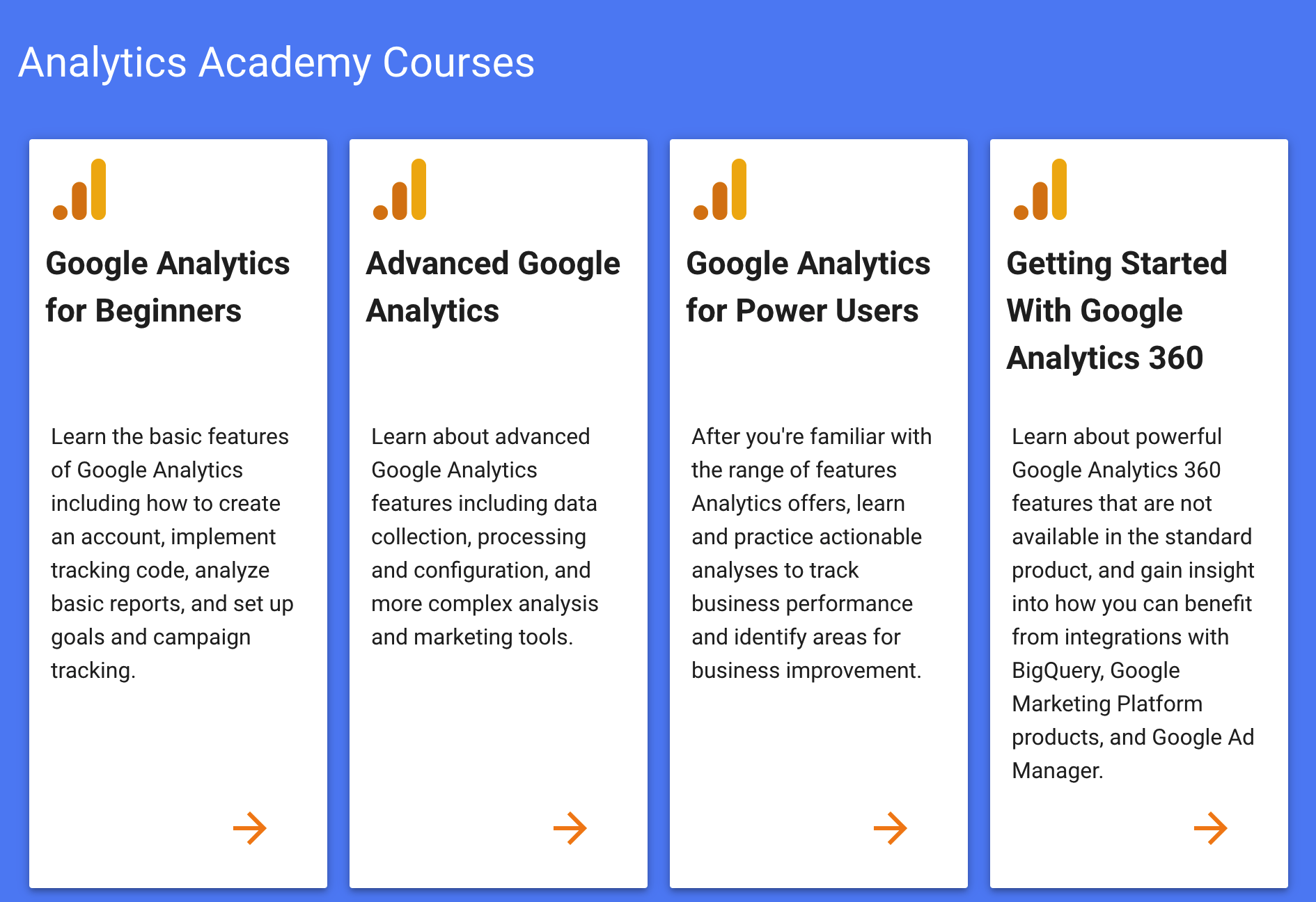
A certification in Google Analytics can help out marketers, digital marketers, internet marketing specialists, developers, and webmasters. The Google Analytics course covers everything from basic principles of statistics to advanced topics like attribution modelling and real-time data analysis. If you’re interested in any of those types of jobs then a Google Analytics Certification is a certification that will help you to be more valuable in the digital marketing field.
Google Partners is a support network for digital marketers and agencies. If you want to take the Google Analytics Individual Qualification (GAIQ), sign up as a partner.
You’ll need an in-depth understanding of Google Analytics and the GAIQ exam to pass. Google’s own guidance and courses are a great place to start if you’ve never used Google Analytics or have only minimal experience using the software. In preparation for the Google IQ exam, you’ll need to cover all of the following:
In addition, if you want to thoroughly learn and understand a subject, you’ll probably need to explore beyond the course content. Google Analytics has plenty of resources available free online for all users, plus there are other methods you can turn to for guidance like below:

The GAIQ exam is made up of individual modules. You can take the module step by step, until you have completed all of the modules. The website states that you have 90 minutes to take the exam.
There are 70 questions, and they consist of multiple choice and true/false. The timer starts the instant you begin, there’s no pausing allowed, with a passing score of 80% or higher.
If you didn’t manage to pass the exam, you’re required to wait seven days before attempting it again.
The Google Analytics Individual Qualification (GAIQ) is a one-time certification with no recurring fees, so the short answer is yes, it’s worth getting. The GAIQ will help you stand out as a marketer to your employer and can provide skills that will boost your income over time (higher rates). It can also be valuable to people such as marketers, developers (including software engineers), project managers or data scientists to excel in data analytics and digital marketing.
In conclusion, it’s worth getting your Google Analytics Certification because it opens up many opportunities to you. It’ll help you to have a better understanding of google analytics and all the methods that there are. Overall, if you’re interested in getting your Google Analytics Certification, go for it! It’s not hard at all and is well worth it!

Are you a project manager looking to take your career to the next level? Then getting the PMP certification is one of the best things that you can do. This article will discuss what PMP is, and why it’s beneficial for your career if you get certified. We’ll also go over how much it costs to get certified as well as who should be interested in pursuing this certification.
In the world of project management, PMP certification is among one of the most coveted. It requires an extensive amount of education and experience to be able to successfully take on a leadership role in this field. The credential shows that you’re ready for anything – from managing your own team, or directing large-scale projects across many departments simultaneously.
PMP stands for Project Management Professional, and it’s a certification that shows your skills in project management. There are many jobs out there where you need to know how to manage projects effectively; so if you’re looking to upgrade from being an employee into starting up your own business or managing other people’s businesses then this certificate will definitely be worth it.
The PMP certification process is designed to help you work with all the necessary components that are in a project management setting. You’ll learn how to handle communication, time and cost constraints as well as understanding what influences these three aspects when it comes to managing projects effectively. The course also covers building your own methodology for approaching any type of challenge.
The PMP certification is based on the Project Management Body of Knowledge (PMBOK). The exam consists of 180 questions that must be completed in 230 minutes. It’s composed of multiple-choice, multiple responses, matching, hotspot, and limited fill-in-the-blank questions PMP do not reveal the passing rate for the PMP exam. The report card format for PMP only shows the target level for each domain: Above Target, Target, Below Target, and Needs Improvement. Based on previous records and updates from PMP in 2005, candidates will need a score of 61% or higher on each section to pass.
As of 2021, the exam fee is $555 for non-PMI (Project Management Institute) members and $405 for PMI members. A PMI membership is $129 annually or a new member paid an initial one-time fee of $10 to join PMI. There are plenty of online resources to prepare for this course. If you’re considering taking this course, it’s important to know what your goals are before deciding on a duration. The PMP certification is done over 120 hours of studying, which consists of learning general knowledge and skills about project management and specific content areas such as planning, executing, monitoring, controlling projects.
PMP Certificates can open many doors when it comes to career prospects. Individuals who hold these high level credentials are ideally positioned for success across multiple industries due their multifaceted skill set; from being able to lead projects themselves, all the way up through elevated managerial ranks like managers, CEOs etc., professionals with this certification really stand out among others holding traditional degrees where there’s less demand on their specific expertise than someone whose focus has been solely around Project Managership.
A professional with project management training is best suited for the following roles:

Here is a step-by-step guide to getting your Project Management Professional certification.
To take the PMP exam, please make sure you have either one of the following:
In order to waive the training requirement, you must have CAPM certification.
To start your application to take the PMP exam, register with PMI and provide basic personal information like educational background and project experience.
Once you’ve been approved, you pay the fee for your assigned test and schedule a time for taking it. You can be notified by email when your eligibility has been confirmed or if there was an issue with your application.
To get ready for the exam, you can either enroll in a preparatory course or study on your own. Coursework should take anywhere from 60 hours to 120 hours depending on how frequently you study.
The exam can be taken near you in a testing facility or online. It takes about four hours to complete the exam.
The PMP certification has a three-year validity period. You’ll need to spend 60 hours of professional development over that time frame to maintain it, or else you can take the exam again.
The answer to this question is subjective; some people may find that the price of getting certified as well as the time commitment are not valuable for their specific needs. However, there’s no denying that if you’re in a field where project management skills will be beneficial then this certificate is essential to your career.
The PMP certification process is designed to help you work with all of the necessary components that are in a project management setting. You’ll learn how to handle communication, time and cost constraints as well as understanding what influences these three aspects when it comes to managing projects effectively. The course also covers building your own methodology for approaching any type of challenge.
To learn more, take a look at the following resources:
No matter what your decision may be, do remember that if you have the time and funds to spare, getting an additional certification never hurts, especially one that will not only level you up (professionally and personally) but will also propel you to a higher position and pay!

In today’s world, digital transformation is everywhere, and we can see evidence of it in our daily lives. In order to be able to provide these different strategies for successful business growth, marketing standards are necessary. Google provides a certification for those seeking a career that will be benefitted by this type of knowledge and skill.
Google Ads Certification is a certificate that Google offers to those who want to be recognised for their expertise in the Google Ads platform.
Skillshop, an online training and certification program offered by Google, is the best place to find a course on Google Ads. There are courses and study materials available, depending on the type of certification you need or prefer to take. A certification from Google is worth it, because they offer updated information on what types of ads work best, and Google offers six different options for certification as below:
Demonstrate the ability to successfully optimise Search campaigns. Candidates who complete the certification process will be able to leverage a variety of automated tools, like Smart Bidding and Audience Solutions, to boost campaign performance.
Validate your expertise in protecting and growing advertising investments using Google Display. Tailor strategies to focus on specific marketing goals that make the most of your display ads investments.
Demonstrate your understanding of how to tell effective stories on YouTube to reach potential customers and drive more demand at scale.
Enhance your knowledge of integrating, optimising, and configuring Shopping ads to improve performance. This certification will also verify you know how to create and optimise Shopping campaigns that maximise reach and conversions.
This Certification demonstrates your mastery of Google Ads planning and advanced optimisation. Certified users will show they understand the fundamentals of campaign creation and more complex strategies for delivering business impact.
This Certification is a certification that can be earned by demonstrating your understanding of using Google’s measurement solutions to measure and track the performance of digital ads.
(*does not count toward the Google Partner badge)
Google Ads certification is suitable for those who want to work in a business that sells products or services online. These are the people responsible for managing advertising campaigns on platforms like Facebook, Twitter and Instagram as well as Google Adwords. This includes everything from writing ads with compelling messages, making adjustments when needed according to specific data (such as how many people clicked on the ad), and following up with customers after they have made a purchase.
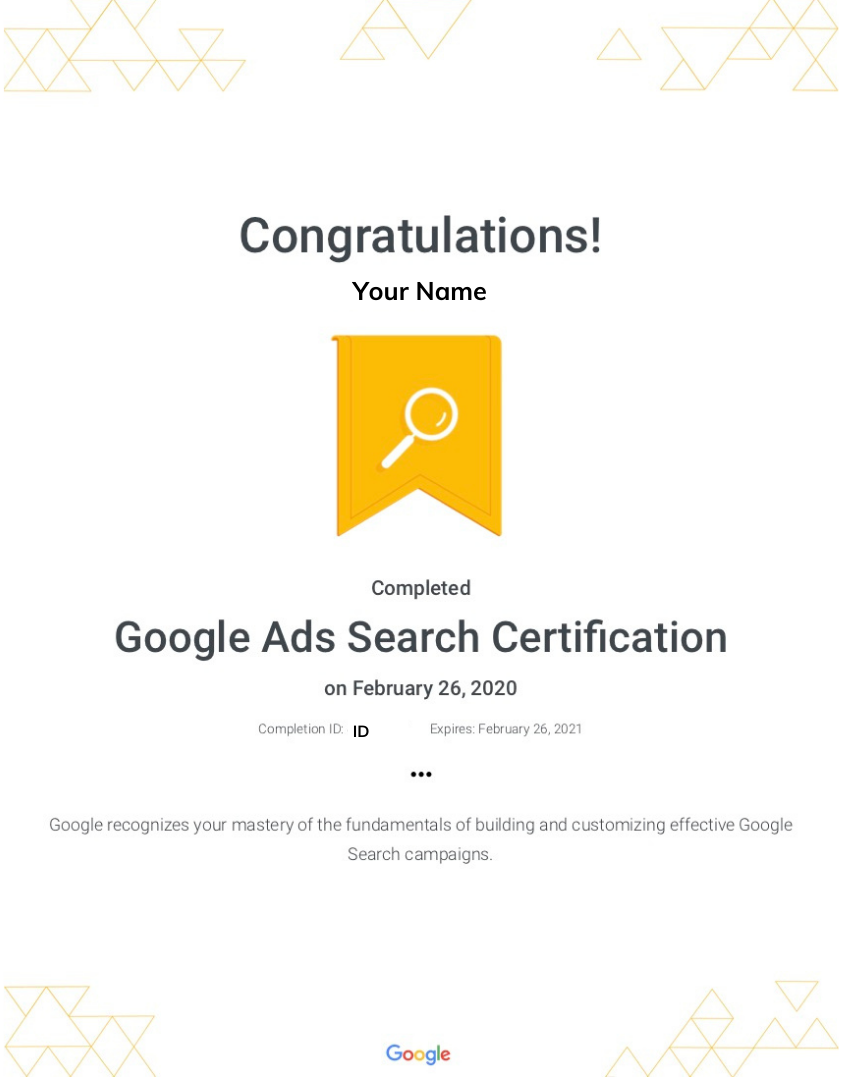
By getting certified, you can demonstrate your expertise to current and prospective employers with a personalised certificate. You can also use Google AdWords certification to help your company become a Google Partner or Premier Partner in the Google Partners program. Jobs that can utilise Google Ads are:
Here are some of the criteria for agencies to be a Google Partner.
All of the exams are free to take and you’re given 75 minutes to answer all the questions. In order to be certified, you’ll need to get at least 80% of the questions correct. Each certification is valid for 12 months once you’ve passed. Each exams are of different length, ranking from 46 questions to 50 questions:
Learning resources for the exams are provided inside Google’s Skillshop learning platform.
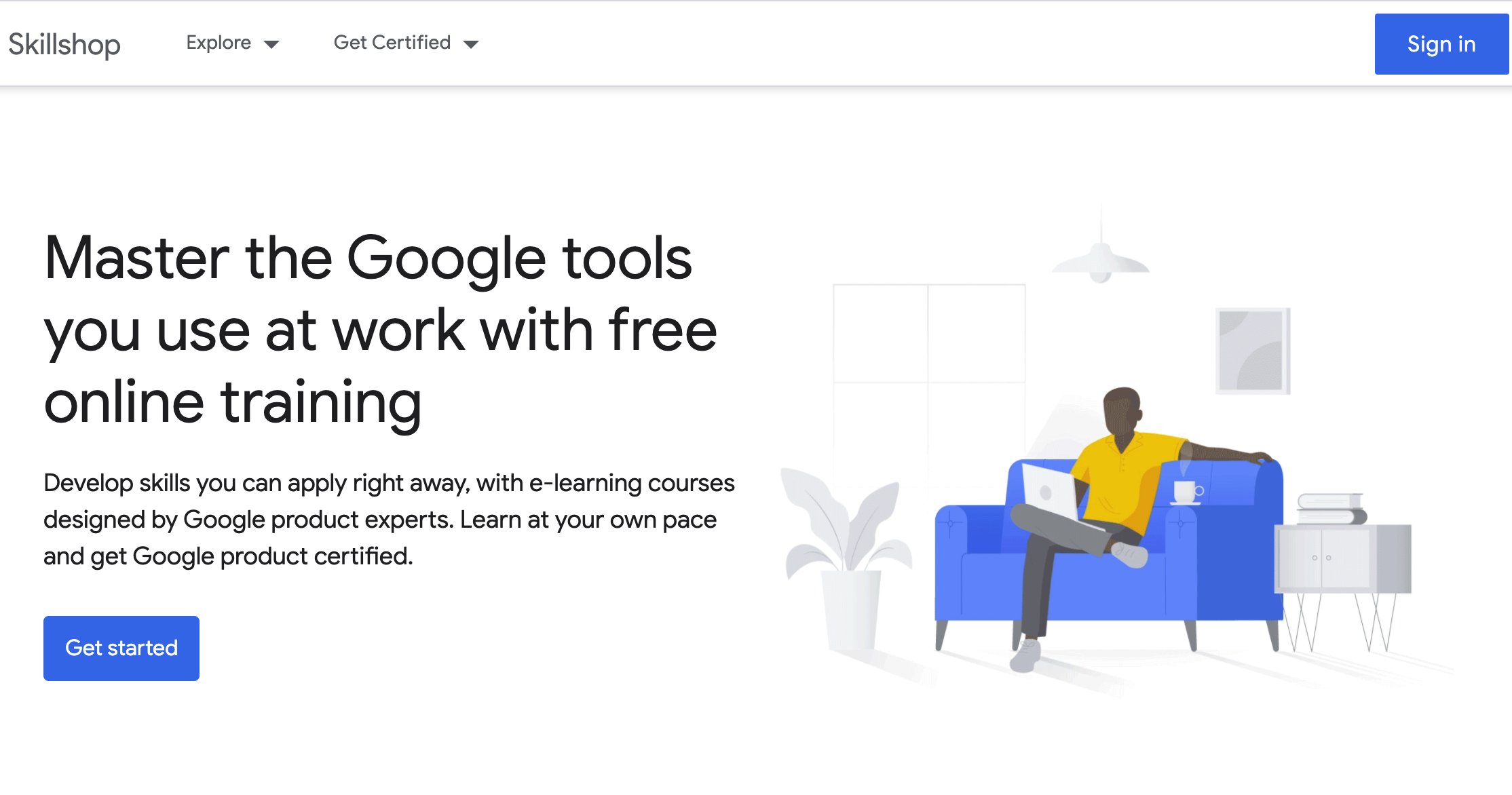
Each of the certifications has study resources.
You’ll need to head to the Google Skillship to take the exams. Once you’re insde Google Skillshop, look at the ‘Explore Skillshop’ section and select ‘Google Ads‘; once you’re in, select ‘Google Ads Certifications` and you’ll be able to see all the Google Ads Certifications offered. Once you’ve selected one of the certifications, look for the ‘Assessment’ option to take the exam.

Certificates are valid for one year since passing the exam. To stay certified, you must have at least two exams (one fundamental and one advanced) at any given time. Your certificates and their corresponding validity can be viewed on My Profile Page of your Google Partners account.
Google Ads are a particularly important part of marketing today, and anyone who wants to work in the online advertising area should get certified. Getting certified will give you an edge over your competitors when it comes to salary or job offers, and the certification is also worth it because Google Adwords changes often. So, if you’re not up-to-date, you’re likely to make mistakes in your campaigns. You should get certified in Google Ads if you’re serious about a career in online marketing and want your employer to know that you’re up-to-date with the latest changes.
Amazon Web Services (AWS) is a cloud-computing platform that allows you to leverage the internet for various types of services. It offers many different tools such as Elastic Compute Cloud (EC2), Simple Storage Service (S3), and Relational Database Service (RDS). AWS certification is available in two categories: Associate level and professional level. Associate-levels work with products and services, while professional-levels work with AWS architecture, deployment, and management.
The Amazon Web Services News Blog provides information on best practices for users who want to take advantage of this scalable web service. Browse the blog, take advantage of the best practices offered by Amazon. You can follow them on Twitter @awscloud for the latest happenings and announcements or download their Android app called AWS Mobile to get access to all excellent features from your mobile device.
The cost of AWS certification is a big factor and the certification is not available at any universities or colleges.
To become an AWS Professional, one needs to take the AWS Architect – Associate exam (which costs $300) or the AWS Certified Developer – Associate exam ($250). To become an AWS Architect, one must take both the Amazon Web Services – Associate exam as well as the Amazon Web Services Architecture – Associate exam for a total cost of $650.
At the moment, AWS certifications are in high demand. For example, LinkedIn Singapore has a total of about 4,477 results for jobs searches related to AWS. Surveyed salaries for AWS-related jobs, ranging from $87,000 to $196,000 annually. The most popular jobs that require these certifications include Solutions Architect, Senior Software Developer – Java, Senior Software Engineer – S3/CloudFront, Solutions Architect / Developer – Security, Solutions Architect – Import/Export and Senior Software Engineer – Web Services.
If you ask if AWS certifications are worth obtaining, the answer is a resounding YES. The certifications open doors to more jobs and higher salaries and in the future (because of its popularity), the certifications may be offered at universities or colleges as well.
AWS certifications can be categorised into various different roles including:

There is also a Specialty Path, divided into five subpaths. The specialization path is segmented based on the AWS Technical Certification which focuses on specific skills relevant to each subset including:
This certification path is intended for individuals who would like to expand their knowledge of the AWS cloud and learn how it can be applied across a variety of different industries. Cloud certification path will help build your understanding in technical, managerial, sales or finance positions that are involved with the use of this service.
This path is designed for solutions architects, solution design engineers and anyone who wants to learn how to take on the responsibility of designing applications and systems that will be built using AWS. There are two architect subpaths:
For an associate level solutions architect certificate, the individuals must show knowledge of how to design and deploy applications in conjunction with AWS tools. These IT professionals need to be able to design highly available systems that are scalable as well as implement proper security measures when deploying these systems. Candidates should have at least one year of hands-on experience designing fault-tolerant networks using Amazon Web Services (AWS).
For a professional level solutions architect certificate, individuals must complete the Associate-level AWS Certified Solutions Architect exam. IT professionals will need to have two years or more experience designing and deploying AWS cloud architectures as well. In order to receive your Certificate in Amazon Web Services Solution Architect at an Advanced Level certificate, IT pros are required to demonstrate knowledge for complex applications including how they can move their application workloads into AWS and design them with enterprise needs in mind.

Developer Path certification caters for those who are interested in learning how to develop cloud applications on AWS. There is an Associate and Professional level, which reflects the depth of knowledge required by each path.
IT professionals must prove their knowledge of code-level AWS application design, development and maintenance to maintain the applications. IT pros are recommended to have one year or more of experience in maintaining an AWS based app before attempting this certification.
The certifications are designed for those with 2+ years of experience provisioning and managing architectures in AWS. This is an excellent opportunity for IT professionals interested in learning more about how they can use Continuous Deployment (CD) automation, among other things, to improve their workflows.
With two paths designed for SysOps administrators and those in a DevOps role, the AWS operations path is sure to spark interest.
This certification proves that the individual has sufficient knowledge in deployment and operations related to AWS architecture and services, including application deployment and data migration; individuals also possess basic system administrator skills in security, provisioning and systems management. This recommends individuals working in a systems admin/operations role with 1-2 years’ experience deploying, managing, and operating in AWS.
In order to be eligible for this certification, individuals will need two or more years of experience provisioning and managing AWS architecture. Achieving the Associate-level AWS Certified Developer or SysOps Administrator certifications can help prepare candidates with technical knowledge on how best to use Amazon Web Services (AWS), while implementing new solutions that drive innovation in IT systems worldwide. Individuals must have a strong understanding in concepts involving continuous deployment (CD) and automation of AWS processes and know how to implement them into AWS architectures.

To be AWS certified big data analyst, individuals will need to have at least one Associate-level certification and five years of experience with AWS big data tools. Additionally, individuals must possess technical skills (specifically about big data architecture design) as well as knowledge on best practices when implementing these structures using AWS tools.
To be AWS certified, a networking professional must have one Associate-level certification and two years of experience with AWS tools. A basic understanding of AWS networking concepts and familiarity with the use of network services (such as DNS, WINS, DHCP).
Achieving the AWS Certified Security certification is a significant achievement for any security professional. It proves that one has obtained foundational knowledge in security, ranging from physical to virtual security; and has experience deploying, operating, and maintaining Amazon Web Services (AWS) in a production environment. Candidates should have at least 2 years of hands-on experience with AWS security services and features of services to provide a secure production environment. Candidates shall also have a clear understanding of security operations and risks.
This certification is designed for those who have a good understanding of how Python and Deep Learning can be used in their work, along with the process of designing a machine learning workflow using the domain. This certification will give data scientists, business decision-makers and developers the chance to learn how they can use machine learning (ML), artificial intelligence (AI) or deep learning (DL). The certifications is geared towards unlocking new insights into what ML, AI and DL are capable of achieving for them. Candidates should have at least one year of experience implementing machine learning solutions on AWS and should also possess knowledge about basic concepts regarding Google’s TensorFlow open-source library for machine intelligence.
The certification is to test the knowledge of an individual for their ability in building, testing and publishing skills. In order to validate this skill, individuals should have a basic understanding on how Amazon Alexa works before applying for it.
Although there is no number of hours currently stipulated, AWS certification can be achieved with a minimal investment in time. The certification exam can be taken online, with Associate-level exams last 80 minutes while Professional and Specialty exams last 170 minutes.
Candidates are expected to have a solid understanding of the core services that AWS provides, such as Amazon S3, Amazon EC2, Relational Database Service (RDS), Elastic Load Balancing (ELB), and Amazon CloudFront. Professional-level exams focus on these AWS areas and will have a larger focus on multi-group AWS tools which includes Autoscaling and AWS Elastic Beanstalk.
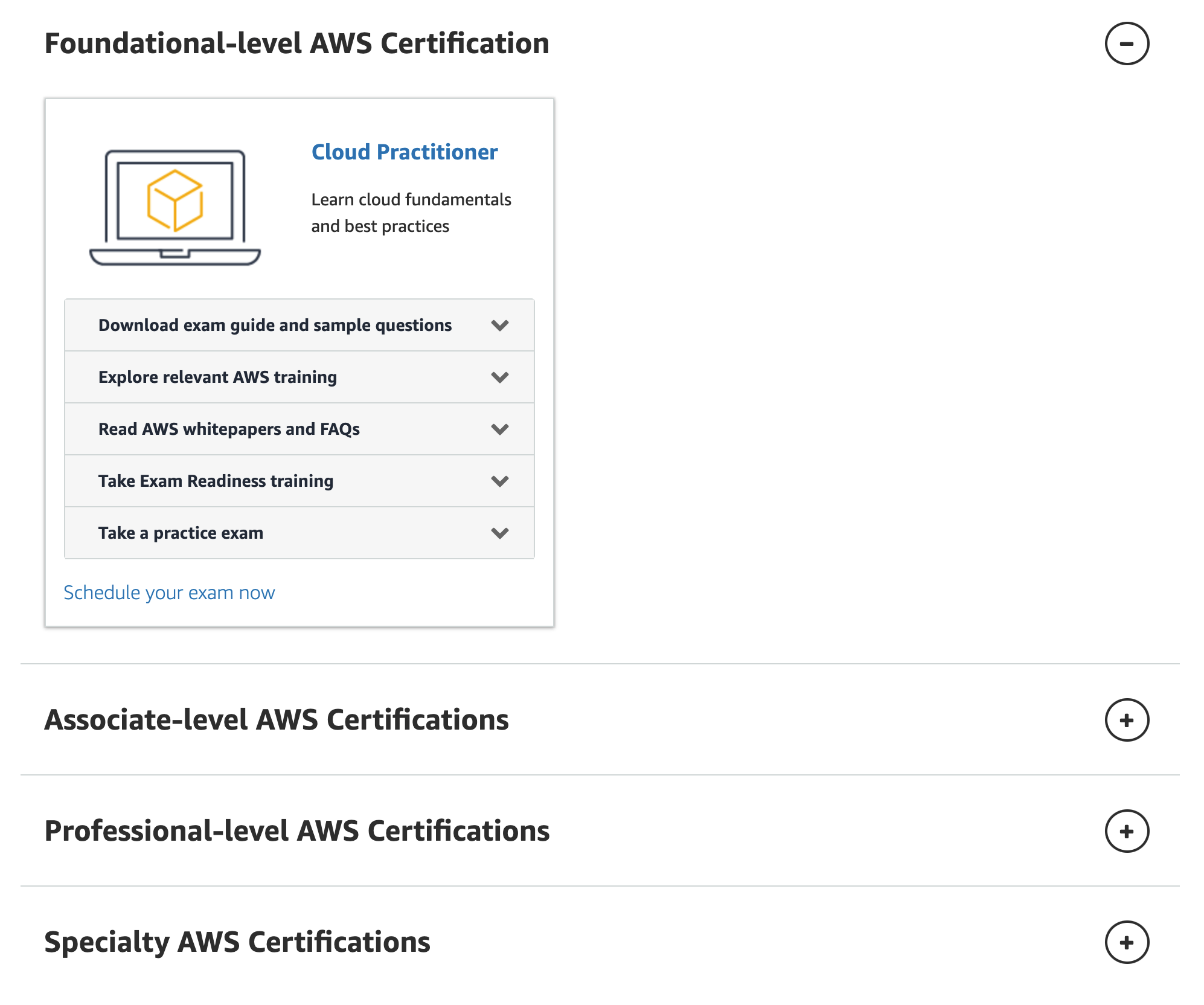
Before taking an AWS Certification exam, it is recommended to explore all the resources provided by AWS that cover exam guides, sample questions, whitepapers, FAQs, practice exam and more.
The certification process includes a multiple-choice examination, which allows candidates to choose their preferred online examination provider (Pearson VUE or Prometric). After passing the exam, successful candidates will be issued an e-certificate and access to specific AWS-certified logos and badges for personal and professional use. IT pros who fail the test can retake it two weeks later.
If you want to make the most of your time and money, it pays to invest in AWS certification. Whether you’re a developer or IT professional with an interest in cloud-computing platforms like Amazon Web Services (AWS), these certifications provide validation for skills that will be valuable as digital transformation continues at full speed. With two types of certification available — associate level and professional level—you can choose which one best suits your needs based on your experience level. In order to apply for any certificate, individuals should have a basic understanding of how Amazon Web Services works before applying for it. If all of this sounds overwhelming but you still wish to pursue certification, AWS has made it easier than ever by providing an education portal on its website, which covers everything from training to practice tests.

When you Google the words “job hunting tips”, you’ll get nearly 100 million results within a fraction of a second. The worldwide web is full of advice about job searching. Some of the information might contradict what you know, and most of it is rather general. Nevertheless, finding nuggets of wisdom on job hunting has never been easier.
We’ve taken the initiative to sift through tonnes of advice and experiences by tech and IT professionals. Here’s a shortlist of job hunting tips to refine your strategy, and make the process much smoother.
The process of job searching is often an emotional roller coaster. It can sometimes be tedious and frustrating and other times, exciting and encouraging. Whatever the case, remember that it’s a normal process. You will eventually attain your goal – to land a great job.
Although the pandemic hit the Lion City hard, the unemployment rate in Singapore is below 4 per cent. Moreover, employers want technology professionals more than any other type of human resource. So, look on the bright side. Most employers want to hire people with your skillset. It’s just a matter of time before the job hunt is over. These tips will make it easier for recruiters to pick you out.
For every IT position advertised, recruiters receive more than 300 resumes. Chances are robots will screen your CV first. Yes, your first reviewer is a robot. But you are a techie, and you know how these forms of intelligence work. Therefore, you have the upper hand.
Make yourself visible by crafting a resume guaranteed to attract the robots. Tweak the wording in your resume so that you use the right keywords. If the job description requires specific skills, and you have them, mention them in your resume.
But be careful not to prepare a resume fit for robots only. It should also communicate to the person doing the first-level screening. It will probably be an admin staff who uses a simple criterion to shortlist candidates. So, make sure you indicate that you have the right qualifications, experience, and qualities.
Skills are vital in your job hunt. If you are a network administrator, but you can also do some coding and cybersecurity, let it be evident on your resume.

Employers in every sector are looking for tech solutions to stay ahead of the competition. The tech pros who are likely to land excellent jobs are those who have multiple skills, and they can prove it.
Remember that technology is dynamic. What was working two years ago could be old now. Boost your skillset by signing up for courses and attending webinars as you search for a job.
Having a broad portfolio of tech skills can make you feel confident enough to join the C-suite. But can your track record, disposition, and leadership abilities show that you are ready?
Tech and IT skills are some of the most desirable in any industry today. However, your resume has to show a combination of skills and personality. Show that you work hard to lead teams, that you can deliver positive results, and you can solve problems. Prospective employers look for these as they debate about hiring you.
Curiosity is the mother of innovation. Your inquisitiveness is an asset. It helps to find solutions that meet client needs and develop better products. Employers want to cash in on it. Find ways to show that you are curious, and it has paid off for your current or previous employers. In the same breath, do be selfish with your time and the resources you need to conduct the job search. It’s one of the most important things you can do for yourself, so don’t let anyone convince you into doing other things for them (like babysitting or running errands). It’s precious job hunting time, and you need it.
Three out of four employers in Singapore use social media as their primary search tool. A significant percentage of these use LinkedIn to look for candidates. If you are not on LinkedIn, or if it has been ages since you last checked your profile, you are missing out on a great opportunity. Review your LinkedIn profile frequently. Let any recruiter looking for a tech professional in your location find you first on the list.
Use these tips to refine your job-hunting strategy. Many recruiters will zero in on your resume and call you for interviews. But be ready for the interviews.
Remember, the prospective employer is interested in what you can do for them. Learn as much as you can about the company, their pain points, and goals. Then present yourself as an asset that’ll help the company attain its objectives.

As an information security analyst, you know exactly how to protect businesses from online threats, but how good are you at writing an outstanding resume? You’re in luck, our guide is designed to help you write (possibly) the best Information Security Analyst resume that you can!
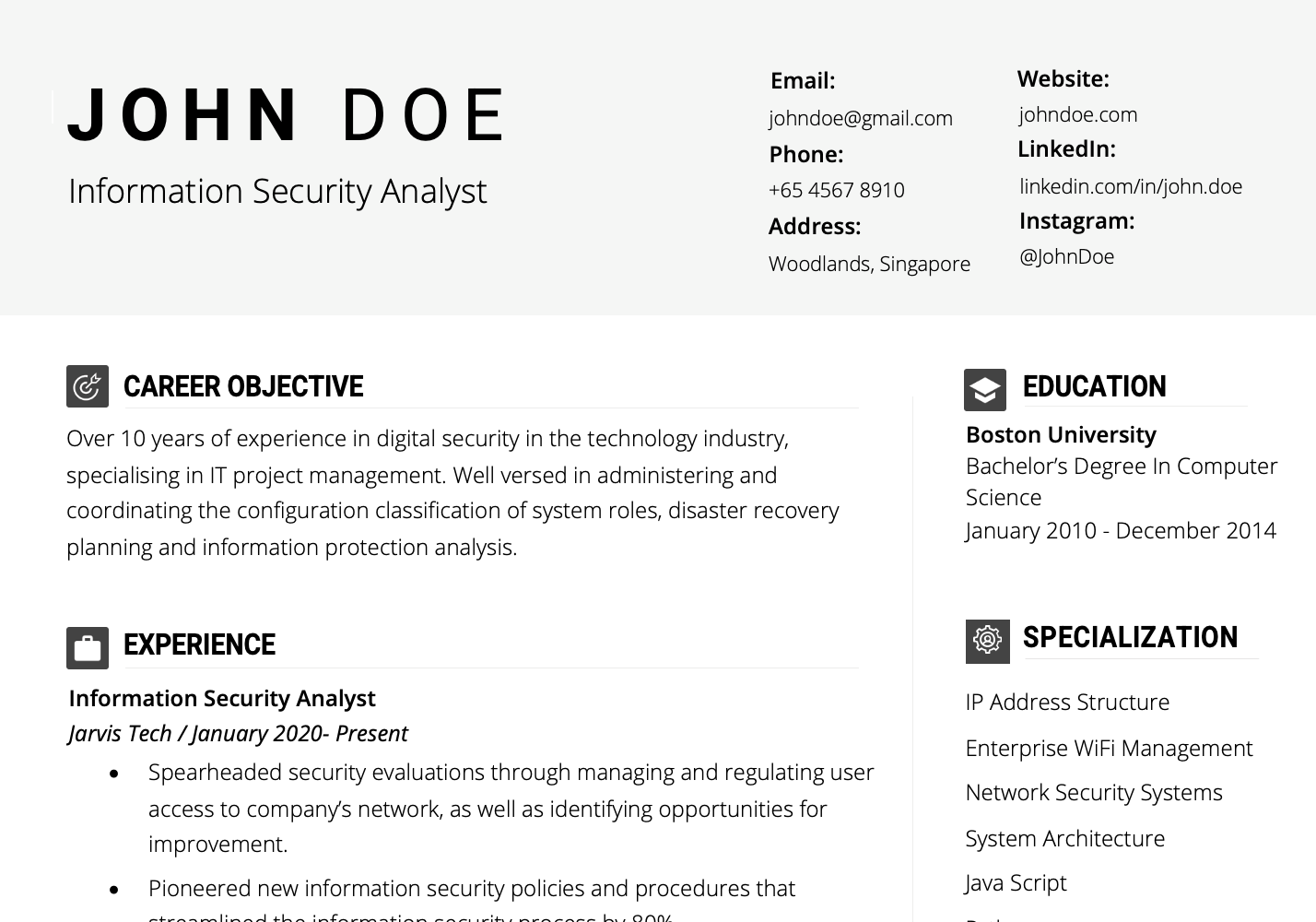
Keep all of the information on one page for a well-received resume. If your career spans further than a decade, you can get away with a two-page resume. Keep in mind that resumes should be concise and targeted.
This is the follow of a resume you should follow:
As for formatting, these are the basics you need to know:
An overview of your professional background, qualifications and drive behind growing your career in this specific industry. Provide a glimpse into why you love what you do, or why you want to grow and develop skills further.
Example: Over 10 years of experience in digital security in the technology industry, specialising in IT project management. Well-versed in administering and coordinating the configuration classification of system roles, disaster recovery planning and information protection analysis.
When drafting your work experience portion of your resume, keep two things in mind: bullet points and specific experience.
#1 Bullet Points
#2 Specific Experience
1) The Job Description: Analyse Indicators of Compromise found in Mediacorp networks with security teams to assess the likelihood of targeted attacks.
2) Your Experience: Successfully spearheaded a team of 15 in Analyse Indicators of Compromise found in Mediacorp networks having assessed 70% of possible targeted attacks.
Pro tip: Exhibit your experience in a reverse-chronological order. It’s one of the most popular and widely used methods for listing your professional experience. It’s much easier for hiring managers to see your most up-to-date work.
Even without any work experiences you can still craft a great resume as someone starting their career journey, after all everyone has to start from somewhere. Here’s what you can include instead of full-time work experiences.
Action words in resumes are adjectives that are used to describe achievements and experiences. It’s a terrific method to get the attention of the hiring manager and highlight your accomplishments.
Words like these are great action words to consider when writing your resume:
Since a resume is short and to the point, here’s what to include and what to leave out.
In a separate piece of paper you’ll want to include the following to boost your chances at being selected for an interview. If you have a website with the following showcased, feel free to include your site under the contact information section of your resume.
If you’ve been meaning to increase your value as an information security analyst, there are a handful of certificates you should look into regardless if you’re starting out or a veteran looking to sharpen your skills. Many are offered solely online with great time flexibility to work with your schedule and learning pace. Here are some certificates worth considering:
Awards are a great reminder of the achievements you’ve accomplished for your company or with your industry.
A cover letter is a terrific complement to any resume because it allows you to go into greater detail about why you’re the best fit for the job. Instead of sending out generic resumes to each potential employer with an open position, a cover letter demonstrates your want to work for the company you’re applying to. The structure of your cover letter matters as much as the content itself.
Make sure the font size and spacing are as easily readable as they are appealing to the eye. When describing your successes and experiences, utilise action words to emphasise your relevant talents to the position you’re wanting to be recruited for.
Need a few more details? Check out our in-depth guides on writing a resume, CV and cover letter. All guides are suitable for any profession with tips for careers across the board.

Establishing a partnership with clients that blossoms into long-term business success, is what a head of partnerships do best. But when it comes to establishing themselves as a candidate for a head of partnership role, it doesn’t come easily to some. Our guide to resume writing for the head of partnership roles is easy to follow with tips on what to include and how to write it.
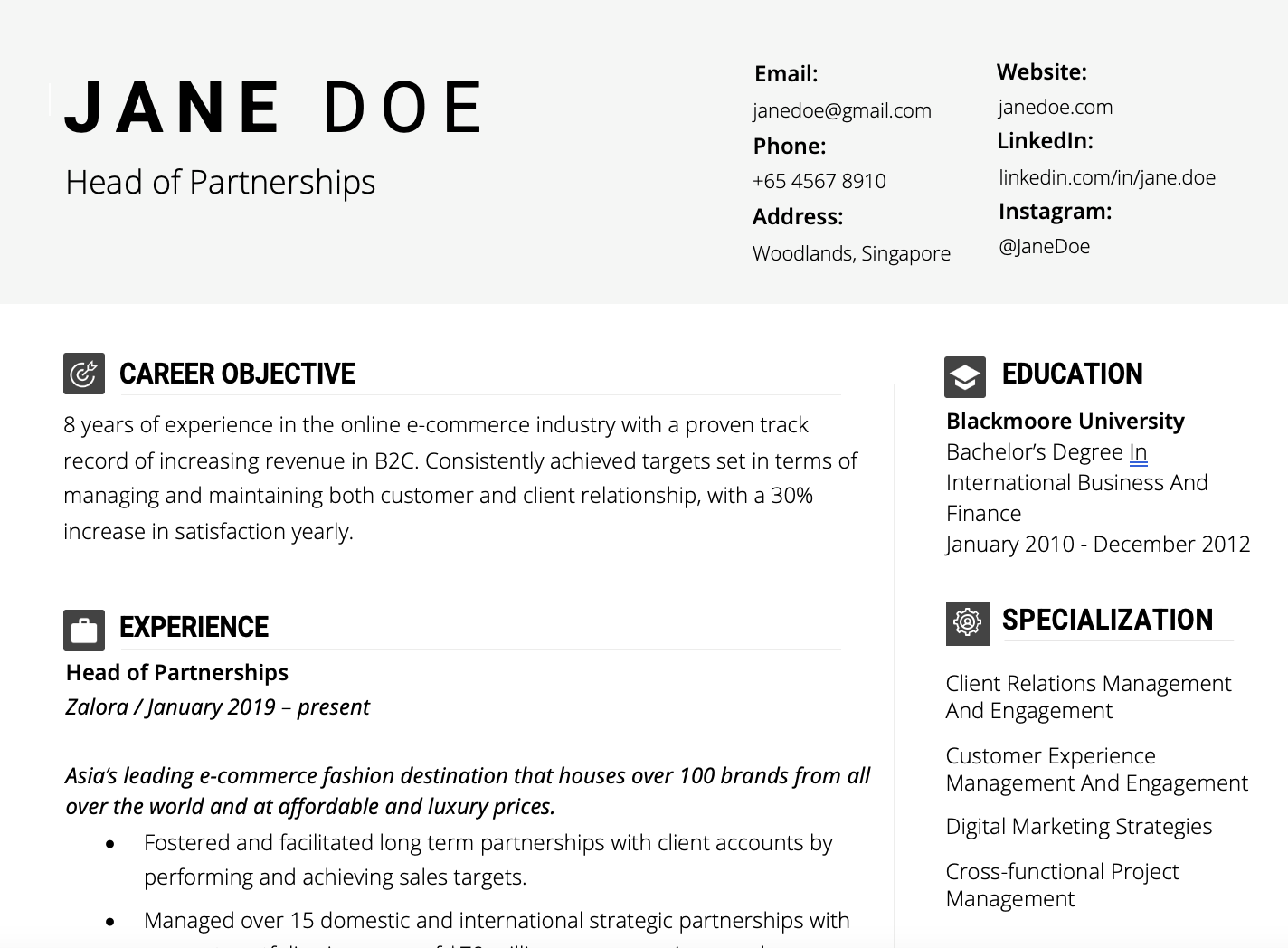
If you want your resume to be well-received by the hiring managers keep all of the information on one page. You can get away with a two-page resume if your career extends more than a decade. Remember that resumes should be focused and concise. This is the flow of a resume you should follow:
As for formatting, these are the basics you need to know:
An overview of your professional background, qualifications and drive behind growing your career in this specific industry. Provide a glimpse into why you love what you do, or why you want to grow and develop skills further.
Example: 8 years of experience in the online e-commerce industry with a proven track record of increasing revenue in B2C. Consistently achieved targets set in terms of managing and maintaining both customer and client relationship, with a 30% increase in satisfaction yearly.
When drafting your work experience portion of your resume, keep two things in mind: bullet points and specific experience.
#1 Bullet Points
#2 Specific Experience
1) The Job Description: Build and grow the partnership/channel ecosystem for the company SouthEast Asia.
2) Your Experience: Fostered several client partnerships into an ecosystem channel that resulted in efficient communication.
Even without any work experiences you can still craft a great resume as someone starting their career journey, after all everyone has to start from somewhere. Here’s what you can include instead of full-time work experiences.
Action words in resumes are adjectives that are used to describe achievements and experiences. It’s a terrific method to get the attention of the hiring manager and highlight your accomplishments. Words like these are great action words to consider when writing your resume:
Since a resume is short and to the point, here’s what to include and what to leave out.
In a separate piece of paper, you’ll want to include the following to boost your chances at being selected for an interview. If you have a website with the following showcased, feel free to include your site under the contact information section of your resume.
If you’ve been meaning to up your value as a web developer, there are a handful of certificates you should look into regardless if you’re starting out or a veteran looking to sharpen your skills. Many are offered solely online with great time flexibility to work with your schedule and learning pace. Awards are a great reminder of the achievements you’ve accomplished for your company or with your industry.
A cover letter is a terrific complement to any resume because it allows you to go into greater detail about why you’re the best fit for the job. Instead of sending out generic resumes to each potential employer with an open position, a cover letter demonstrates your want to work for the company you’re applying to. The structure of your cover letter matters as much as the content itself.
Make sure the font size and spacing are as easily readable as they are appealing to the eye. When describing your successes and experiences, utilise action words to emphasise your relevant talents to the position you’re wanting to be recruited for.
Need a few more details? Check out our in depth guides on writing a resume, CV and cover letter. All guides are suitable for any profession with tips for careers across the board.