

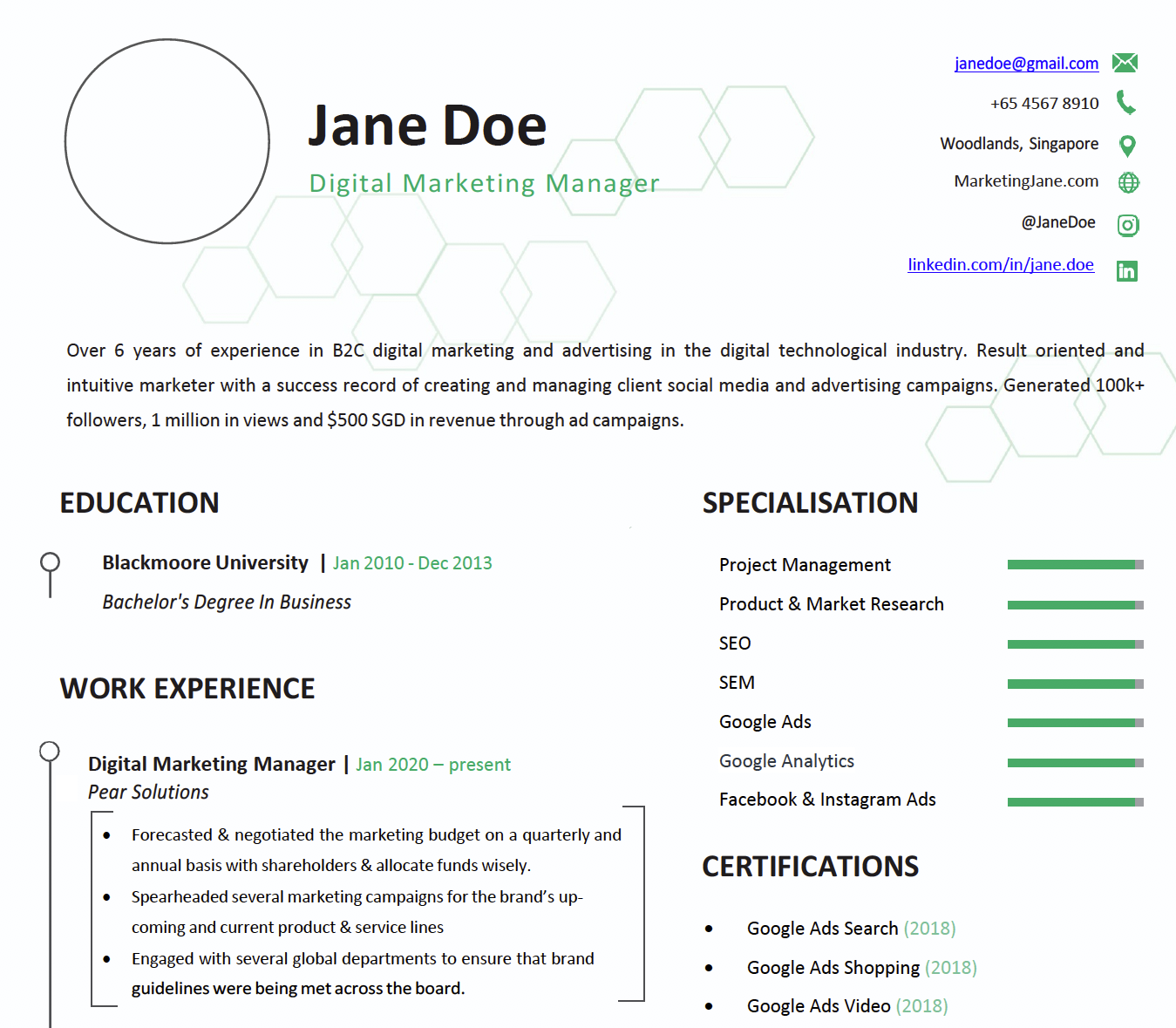
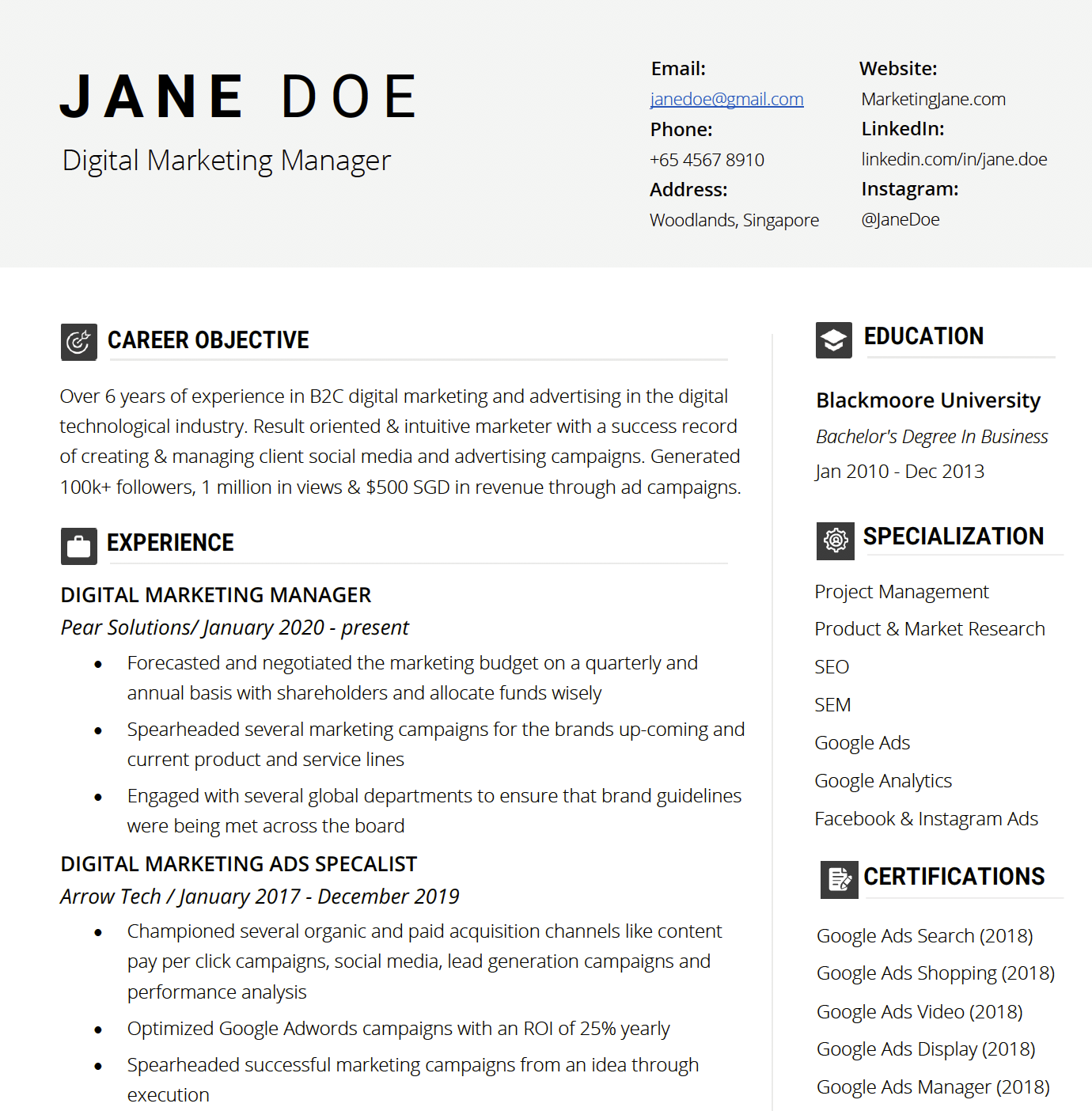
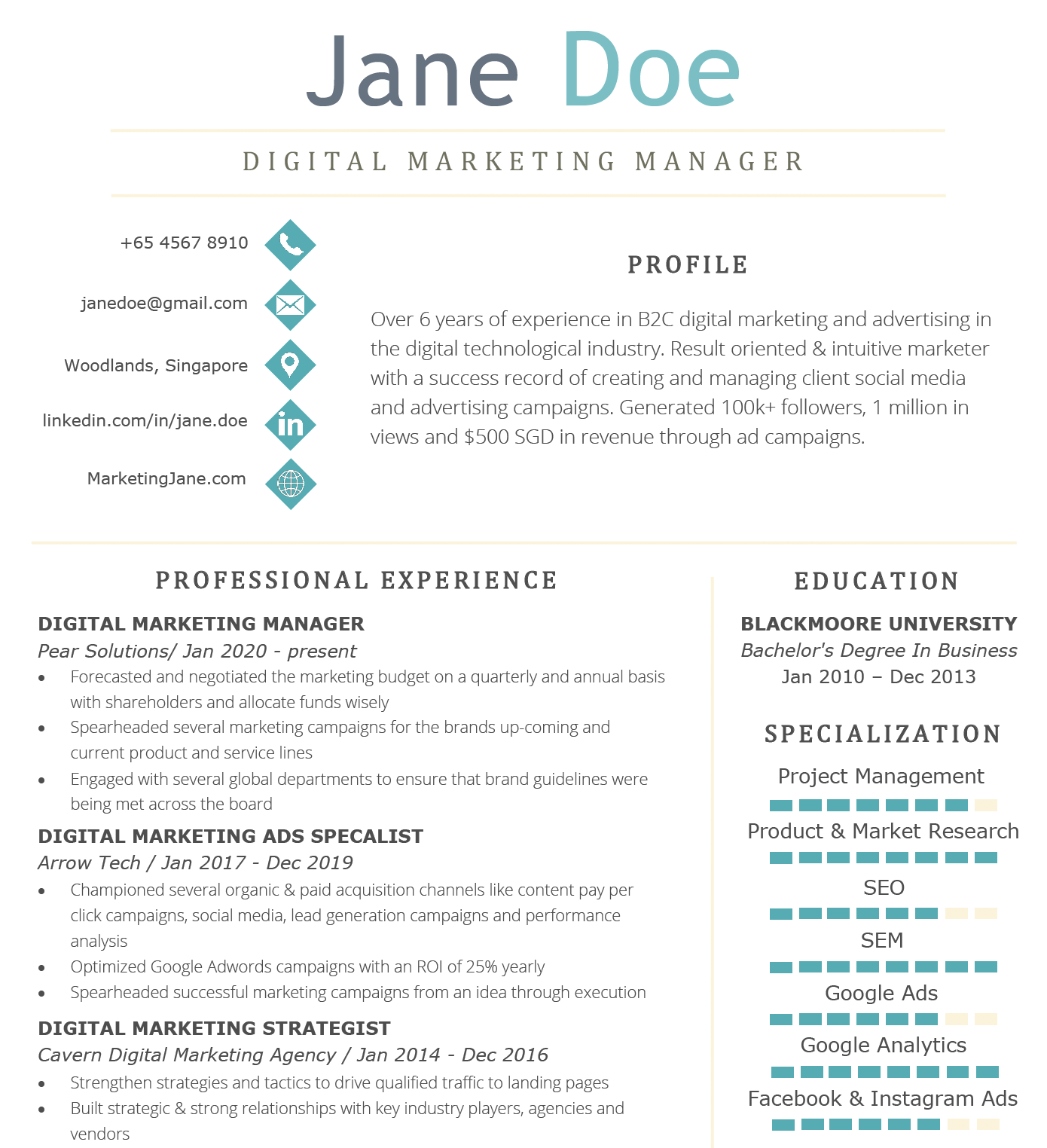
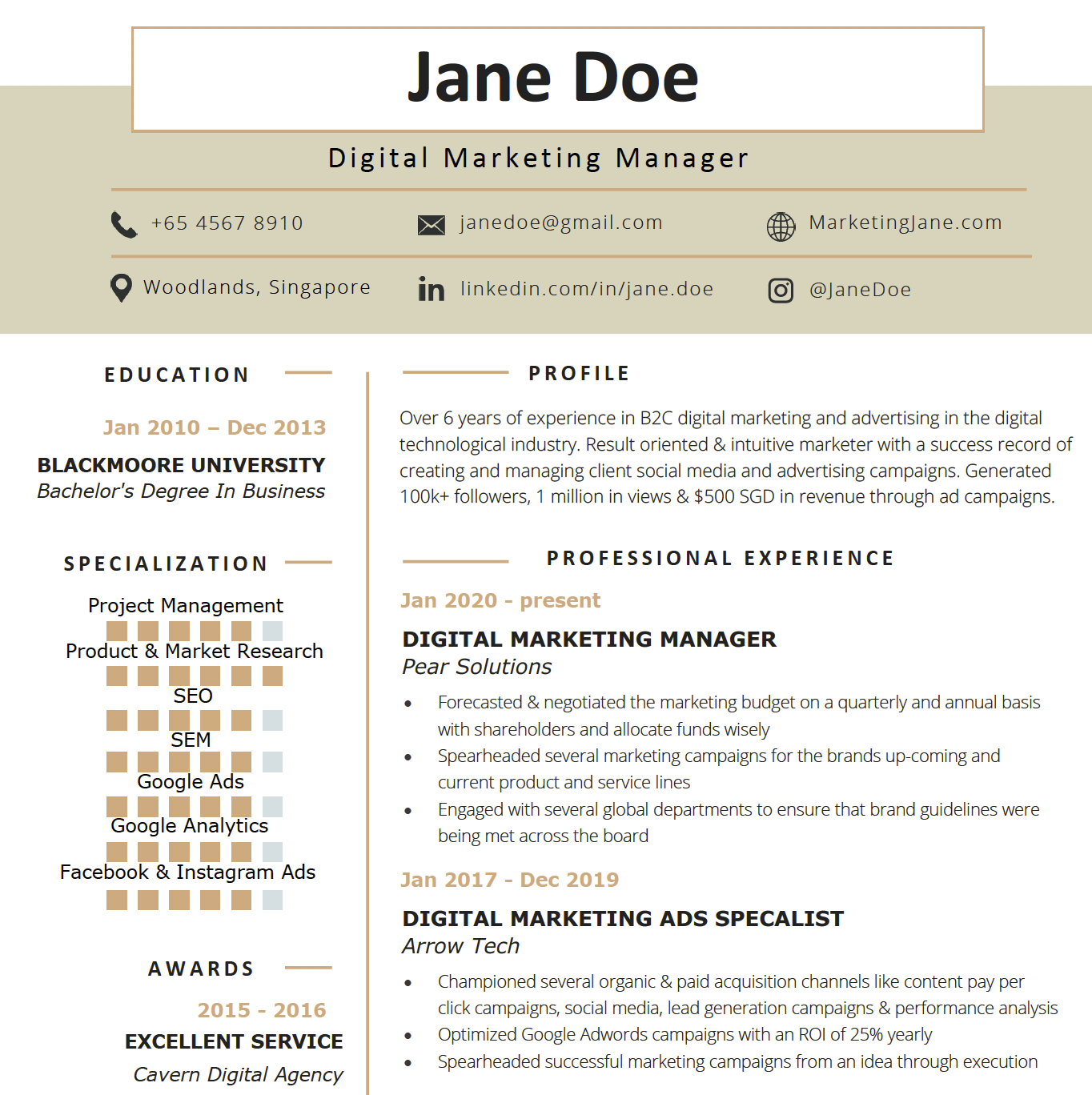
Free, professionally-designed resume templates for you to customise and use at will. Each resume template is designed to meet the standard of what an excellent resume should look like. Stand out from the crowd, get noticed, and get hired with our free resume templates.
First impressions are everything, especially when it comes to applying for a job. A resume is that first introduction between you and a potential employer. It communicates your qualifications and helps you stand out from the sea of applicants when written right. It’s your first step across the threshold and to an initial interview.
Short and to-the-point, a resume is a summary of your work experience and skill. Don’t see it merely as an overview of your job history, but instead as a means to convince potential employers that they should interview you.
The key to a well-received resume is to keep all the information on one page. However, if your career spans longer than a decade you can opt for a two-page resume at most. Keep in mind that resumes are short and specific.
The order in which you lay out the specific information is also important when it comes to writing a resume. Start with the most important information first, experiences, skills and contact information, before including academic successes. By arranging information this way, it’s much more pleasing to read from a potential employer’s perspective. With all of this in mind, you might be wondering…
It’s tough to stand out from the crowd of applicants, and when you do you’ll want to make sure it’s for all the right reasons. So don’t miss a beat with this quick resume checklist in this order:
First and foremost, include your first and last name, phone number, and email address. Feel free to add your LinkedIn profile if yours is up to date, and even your social media profiles if it applies. Don’t forget your mailing address to prove you live near the place you’re applying if it’s a requirement.
An overview of your professional background, qualifications and drive behind growing your career in this specific industry. Provide a glimpse into why you love what you do, or why you want to grow and develop skills further.
Only list relevant work experience you have concerning the specific job. Include your title, the company you worked for, years worked, and two to three bulleted points list your key responsibilities and achievements.
The skills you possess and the skills you include in a resume are not always one and the same. Remember to list only the key skills the position requires, read the job description for guidance on this and search online for skills that are relevant to the position. Include a mix of hard and soft skills where necessary.
Include the names of schools that are most recent and relevant, highest diploma, degree or PHD earned, majors and minors. Your GPA should only be included in the job description mentions it, or if you want to include it.
Towards the end of your resume include certificates and awards you’ve earned during your career. They should highlight your list of skills and accomplishments.
Don’t include languages where stringing together a simple sentence shakes your confidence. Only include languages you can confidently speak, read and write at a work-appropriate proficiency level. Even then try to tailor the languages you include to the job description or where the company is based.
Now that you know what to include in a solid resume, here’s…
By this point you already have it memorised that resumes need to be short and to the point. A wall of text is the complete opposite of it and is still a mistake that one may easily make.
If you find yourself writing a wall of text, take a minute to extract the important information and simplify it into a sentence at an average reading level. Make sure to do this in two to three bullet points that highlight what the wall of text was trying to convey.
Reducing the font size might seem like the solution to freeing up space to include more information. But this could easily backfire. If the text is too small it can be easily deemed unreadable by both a potential employer and AI.
Emphase your most relevant abilities and utilising bullet points or brief phrases to keep the word count down and leave some white space on the page for a clean visual appeal. Use a clear, easy-to-read font in a reasonable size of either 11 or 12, and most importantly think about how your resume will look on the page.
You should avoid sounding repetitive, and the best way to do so is by removing the use of “I” in any sentence. You want to write your resume from another person’s perspective, even in your profile summary.
Keeping your resume short with all the achievements, skills and experience you’ve gained during your career might seem almost impossible to do especially if your career thus far has been a long one.
The best way to ensure your resume is only one to two pages long is to tailor it to the specific job you’re applying for. You’ll be able to narrow down attributes that are in line with the job description. This will ensure that you don’t go over two pages.
But what if you believe all your job experiences are valid points to be highlighted? Then you’ll only want to include two to three short points of your achievements with each company under experience.
It’s not always possible for a single resume to perfectly fit every job opportunity that comes your way. Some will require you to highlight different career achievements over others, and knowing when to showcase certain points and skills to different employers will work as an advantage.
Creating multiple variations of your resume for different specialisations within an industry will help potential employers to envision your attributes in the role that they are hiring for. By catering your resume to the specific job description you’ll also only be including experiences and skills that are relevant to the job, thus saving time as to what to include and space.
Resumes don’t only begin to all look the same to an employer after the first 10 resumes, but they all start to read the same too. Action verbs are a great way to draw attention and spark interest in your resume.
Action words are adjectives, and the easiest way to indicate the use of an action word is to imagine the word “I” in front of it. When you’re listing your bullet points make sure that the first word is an action word. Mix it up by looking up synonyms for action words that pack a punch. Examples would be using integrated instead of combined or using forecasted instead of estimated.
Resumes can be tedious to write especially when you need to have multiple variations. Over time and with practice writing a resume can easily become second nature.
You now have a solid understanding of what a resume is, what to include, what not to include, and tips on how to make your resume work for you instead of against you. Just remember to keep it short, simple and to the point and you’ll be a shoo-in for an interview.

Free, professionally-designed CV templates for you to use at will. Each CV template is designed to dazzle employers, and is ATS-friendly. Stand out from the crowd, get noticed, and get hired with our free CV templates.
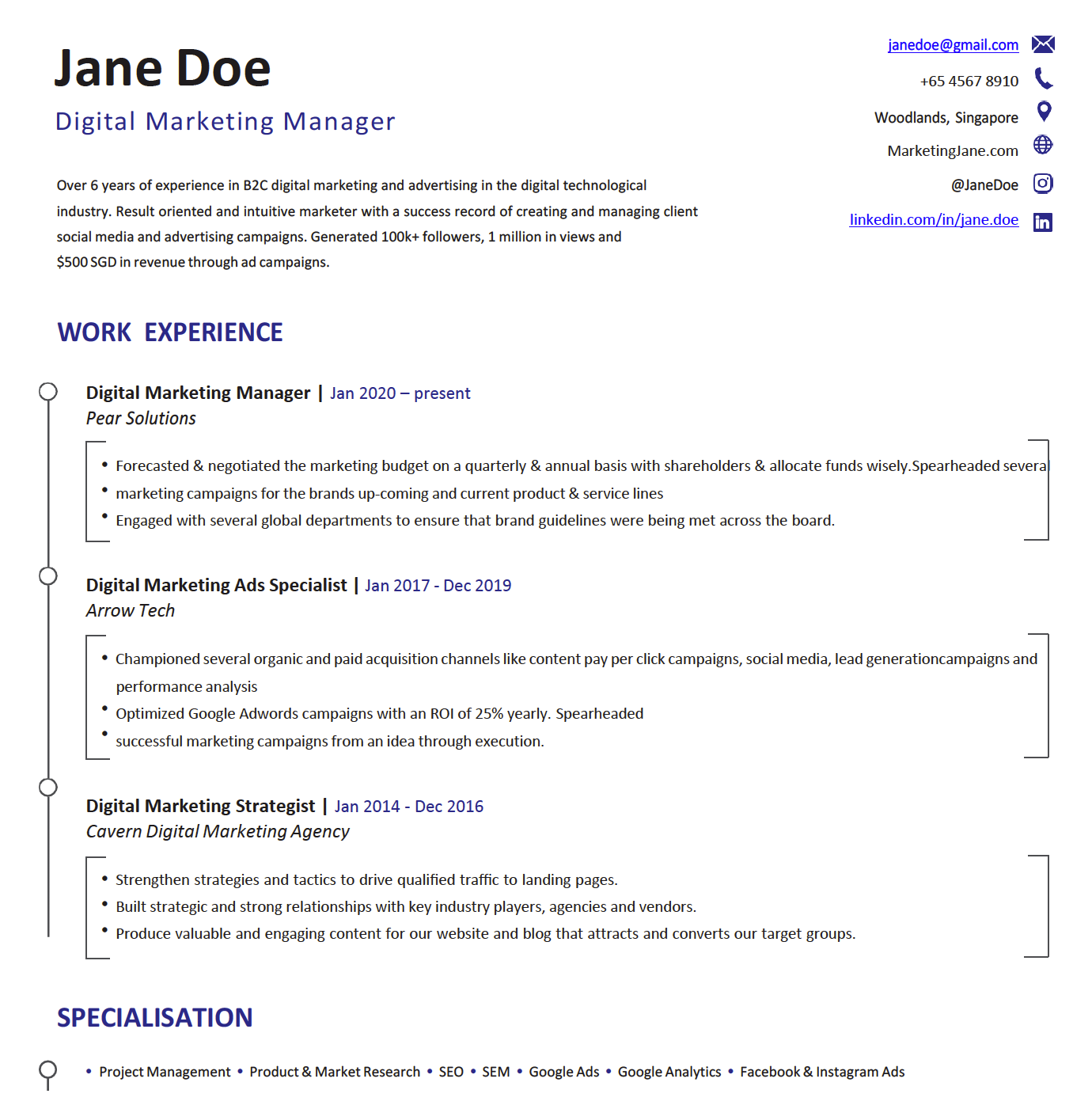
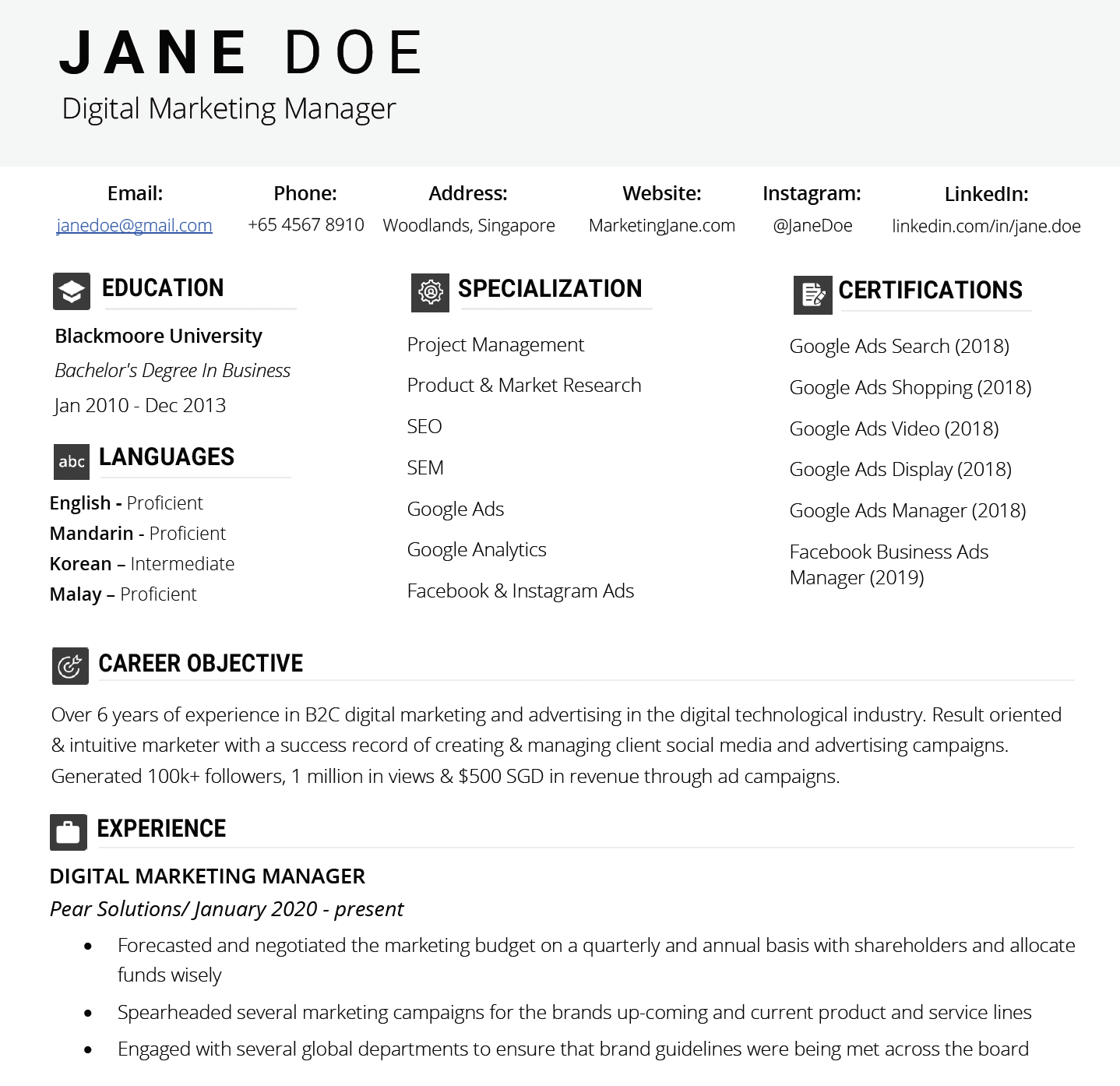
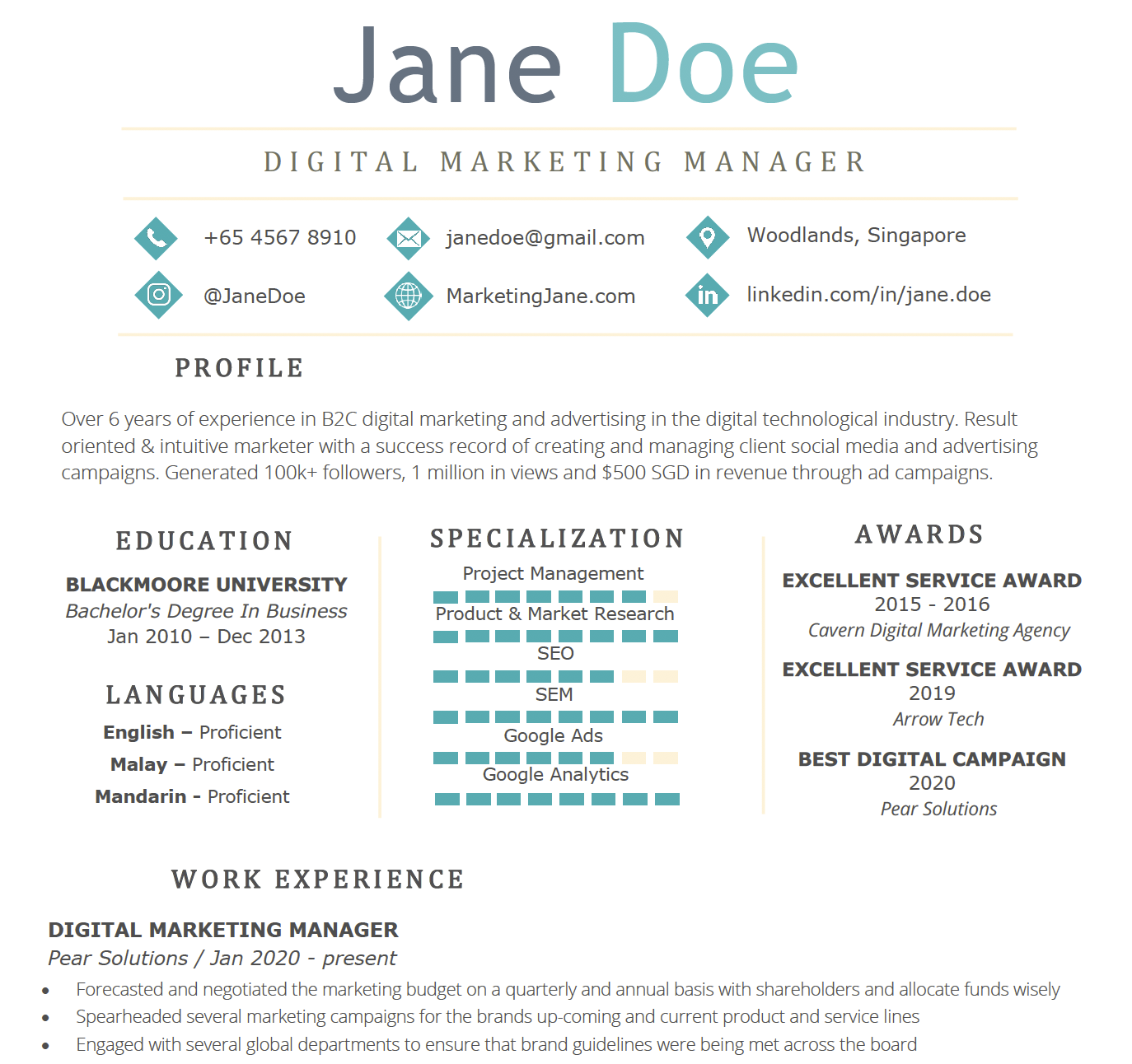

‘Curriculum Vitae’ is Latin for the course of life, but it is the abbreviation of the term that you’ll be familiar with, CV. It’s a comprehensive description of your career journey and professional accomplishments thus far.
Your CV is a potential golden ticket to an interview with your dream company. It is the first impression your potential employer has of you before meeting you. Making sure you’ve covered all the bases of what to include in your CV is as vital as spelling and grammar.
When writing a CV you’ll come to realise that it may stretch to being two to eight pages long depending on the years of experience you possess. However, this doesn’t mean you should go off on a tangent about your experience or education. You should instead provide a handful of single sentence bullet points.
A CV’s format is also important to consider, as the information layout flow should create interest and highlight your achievements. Your name and contact information should come first, then followed by a summary or objective of your career journey. Have your most recent experience listed next, and the order should be your most recent experience first, and work your way backwards.
Here’s a quick rundown of the order in which you should list information on your CV:
Include your first and last given birth name on your CV. *During the interview feel free to notify the interviewer of the name you’d like to be called.
List your phone number and the work email address you check most frequently. If it’s appropriate, include your mailing address to establish that you live close to the location where you’re applying.
Your summary should consist of your professional background, qualifications, and motivation for advancing your career in this field and job position. Indicate why you enjoy what you do and why you wish to develop and improve your talents.
This section of the CV should not be lengthy and stay within 50 to 200 words at most. When writing your summary remember that you’re telling a compelling story about your career and who you are as a professional.
List all relevant work experience, from your internship to your most recent position. Highlight your responsibilities and achievements in those positions in one-sentence bullet points. Each experience should have a minimum of 3 points and 6 points at most.
Provide the names of the most recent and relevant schools, and the highest diploma, degree, or PhD attained, as well as majors and minors. Include your final GPA for each educational certificate you’ve received.
List in bullet form the full names of published papers and books. Do this in the order of publication with dates. If you’re in an industry where you’ve published career-relevant papers or books, include them, if not just skip over that section.
The skills you list on your CV should be the skills you’ve developed throughout your work experience, reflecting the most important skills the role demands. Read the job description and conduct an online search for skills that are relevant to the role. Wherever possible, combine hard and soft talents.
Include certificates and awards as a highlight of the skills and accomplishments you’ve earned during your career from independent organisations and ones you’ve received from previous employers.
In your CV be sure to list all the languages you speak, read and write proficiently and with confidence. Avoid including a language you only understand but have no experience speaking or writing.
Remember to keep your CV as updated as possible even when you aren’t actively looking for a new role. Now that you have a better idea of what to include in your CV, let’s look at…
Your CV, just like the ones other applicants send in, will be a few pages long depending on the length of your career. This is why you must avoid sounding repetitive within your CV. Removing the use of “I” throughout your CV will allow for a better read through.
References are often requested later on in the interview process, thus are not necessary to be included in your CV. When asked, provide a handful of up-to-date references that you know will provide a glowing and honest review of your talents and achievements. These should be a mix of team members and management.
After reading the first 10 CVs in a row, it’s understandable that your potential employer might begin to question if they’ve been reading the same CV over and over again. The use of action verbs will create interest and provide a greater emphasis regarding your experiences and accomplishments.
Action words are adjectives, in the case of a CV, these are words that help you describe the impact you had on tasks, projects and organisations. Indicate the use of an action word by simply imagining the word “I” in front of it. When listing your bullet points make sure that the first word is an action word.
The great thing about a CV is that space is not an issue, this is because your CV can be anywhere between two to eight pages long. There’s no need to reduce the font size for any reason. You should use a clear, easy-to-read font style paired with a reasonable size of either 11 or 12. When formatting your CV, keep in mind to leave a good ratio of white space in order to avoid looking cluttered.
Emphasise and provide a more visual idea of your achievements with the use of symbols when listing your work experience. Here’s a breakdown of how to correctly and effectively include them in your CV:
Dollar amounts ($)
Percentages (%)
When you’re listing the following information, ensure that everything is as accurate as possible. Make sure to keep the statement simple, explain how the numbers were achieved in the same statement.
Writing your CV for the first time can be just as overwhelming as updating it the 5th time. Once you have your foundation of information ready to go, formatting and tweaking the language will be much easier. Make sure each statement is accurate and to the point, and your potential employer will thank you for it with an invitation to interview.

Whether it’s a top technology company or a small startup, employers all love one thing – professionalism! It doesn’t matter if you are a veteran or a greenhorn straight from college, company heads love professional, respectful candidates.
But, there are times when you may feel like you want to loosen a little, especially if the interviewer is an acquaintance or someone who looks like a peer. Sometimes, the prospective employer could arrange a meeting at a restaurant and you may want to let your guard down. It’s crucial to maintain professionalism throughout the job hunt, even when it seems difficult to stick to the code.
Read on and get tips to help you maintain professionalism when job hunting.
When the employer arranges a semi-formal meeting, it’s easy for the conversation to stray to personal matters. Try not to give too much unnecessary information (TMI) – even if your counterpart does. For example, if the interviewer starts a Monday morning interview with tales about a wild weekend, avoid carrying on with the conversation. You could end up giving too much information. Instead, you can respectfully acknowledge how they feel and wish them a quick recovery.
The same applies when the interviewer digresses into discussions about relationships, politics, or lacks decorum. Don’t be the “Yeah man, me too…” person. You will give too much irrelevant information that could hurt your chances of landing the job.
Social media is a powerful job hunting tool. Three quarters of recruiters in Singapore use social media to find job candidates. A platform like LinkedIn allows job hunters to connect with many peers and network with several potential employers.
You could be tempted to stalk your prospective interviewer or would-be boss. But you must resist it. If you must follow or like them, do it with caution. Avoid following or liking the person’s social media profile. Instead, connect with the organization’s profile. And when you want to like, or engage on social media, do it professionally.

Perhaps the person you want to send an email to is a peer or a former colleague. You may want to send a quick email after the business lunch. Keep the contents of the email professional.
Address the person appropriately, using words like “Dear Ms Jamie.” Avoid shortened forms or informal language like saying “Hi,” or “Thx,” and don’t use emojis!
Also, avoid using too many acronyms or too much jargon in your emails and letters. Instead, try to keep the communication simple. The addressee may be familiar with the industry’s technical terms. But, if you want your email to be memorable and easy to read, reduce the jargon.
If the employer requests a taste of your service on a trial period, try to build a good rapport with her and other workers. You have a better chance of landing the job if the team likes you. Create a professional rapport, but don’t overstep it.
How do you do that? Avoid potentially controversial topics like politics and people in your discussions. You never know when someone could be offended. Also, remember to keep it professional when you are hanging out, away from the office.
Tech companies often don’t require their staffers to dress formally. Apart from team members who handle the business side of things, it’s hard to find an engineer dressed up in a business suit and tie analyzing the company’s system. But that’s not a green light to look shabby.
Don’t go to the workplace dressed down in jeans and a T-shirt. Look like someone who wants the job and is professional about it.

Although there are more than 1,000 tech startups in Singapore each year, the human resource pool is not very broad. It’s easy to find a former colleague or a friend conducting the recruitment. SMEs which employ more than 70 per cent of the workforce in Singapore, often have a flat staff structure.
Many don’t mind employees dressing down and having informal communication. Although it may seem okay, it’s not a green light to be casual or unprofessional. Look for ways to tweak your correspondences and conduct to fit the job and preferences of the potential employer. As long as you are still job-hunting, keep it professional.
These tips will help you keep it professional. But remember to be on point with other positive job-hunting skills. Don’t be late for interviews, prepare well in advance for meetings, and get help crafting a powerful resume and convincing cover letter.

As the tech industry keeps growing rapidly and various new technologies such as AI, Big Data, mobile applications, Internet of Things (IoT), etc., are making their way to be a part of our daily lives, the demand for tech specialists across the globe is on the rise as well.
In fact, the talent gap is already a major problem in the tech industry today. The demand for specialists in development and implementation of high-tech innovations keeps increasing, while the supply is unable to catch up. The United States, for example, will have a deficit of over 500,000 software developers by 2024, according to a report by Forrester Research.
Booming demand drives new people in this profession, while more experienced software developers, are often wondering if there’s real career growth potential for them, which positions to apply to if they want to reach a higher level, and how long you can actually stay a full time software engineer. And these are the questions we will try to answer today!
Many people who want to become software developers, and those who are currently working in this profession, are wondering how long an average career in software development can last. Since software development is a very young occupation that became mainstream only in the 1990s-2000s (and the tech market keeps changing rapidly), it’s quite difficult to make long-term projections.

We do know, however, that software developers in general tend to stay in this profession long-term and typically are not looking to switch to other occupations.
According to Stack Overflow’s Developer Survey 2020, probably the largest professional developer survey in the world with around 48,000 respondents, there’s a considerable number of professional coders who are staying in this profession for decades. 33.6% of responders or slightly over 16,000 people said they have been working as software developers for more than 10 years already. 11.4% or 5,447 people surveyed said their professional career has been ongoing for more than 20 years.
There’s also a shortage of real veterans – people who have been working as software developers for more than 40 and 50 years! Specifically, 0.4% or 191 out of 47,779 professional developers who participated in Stack Overflow’s survey said they have been coding for more than 40 years. And 48 people have been in the profession for over half a century.
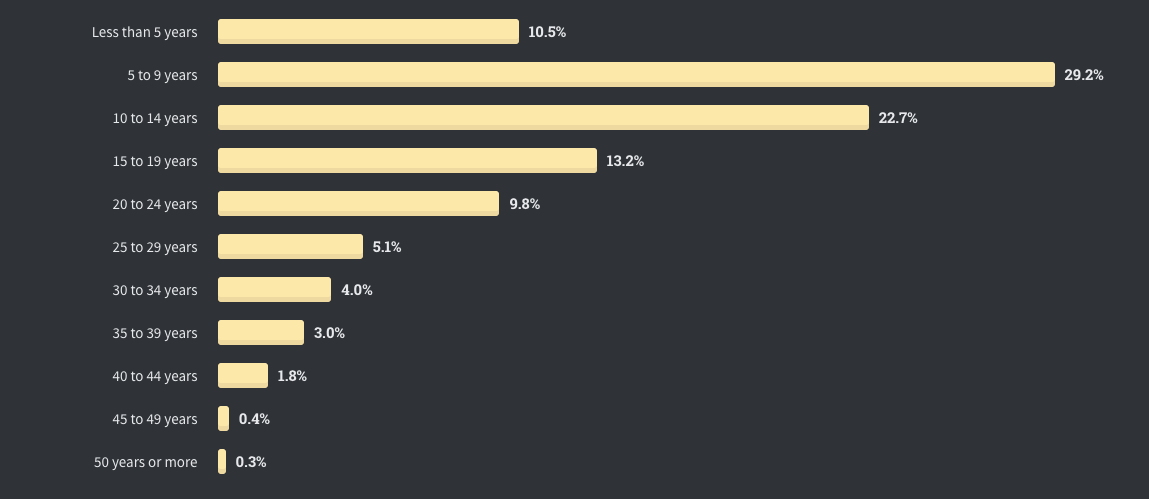
Interestingly, another research shows that software developers are the least likely to leave their profession among all professionals in general across all the economic sectors. In the list of 20 jobs with lowest career-switch search rates various programming-related roles, such as Network Engineer, Web Developer or Java Developer, hold 7 positions.
That being said, there’s a popular misconception about software development as a more or less dead-end job with not much room for growth after you reach Senior Developer level, and the majority of Senior programmers stay in these jobs for so many years because they don’t have other options.
In reality, there are multiple career paths that are open to individuals with coding and other technical skills. Here’s a list of career paths and specialisations in the tech industry you can switch to from being a software developer.
When it comes to career growth in the tech industry, for talented software developers sky’s the limit. Here are a few roles and positions experienced software developers can grow into.
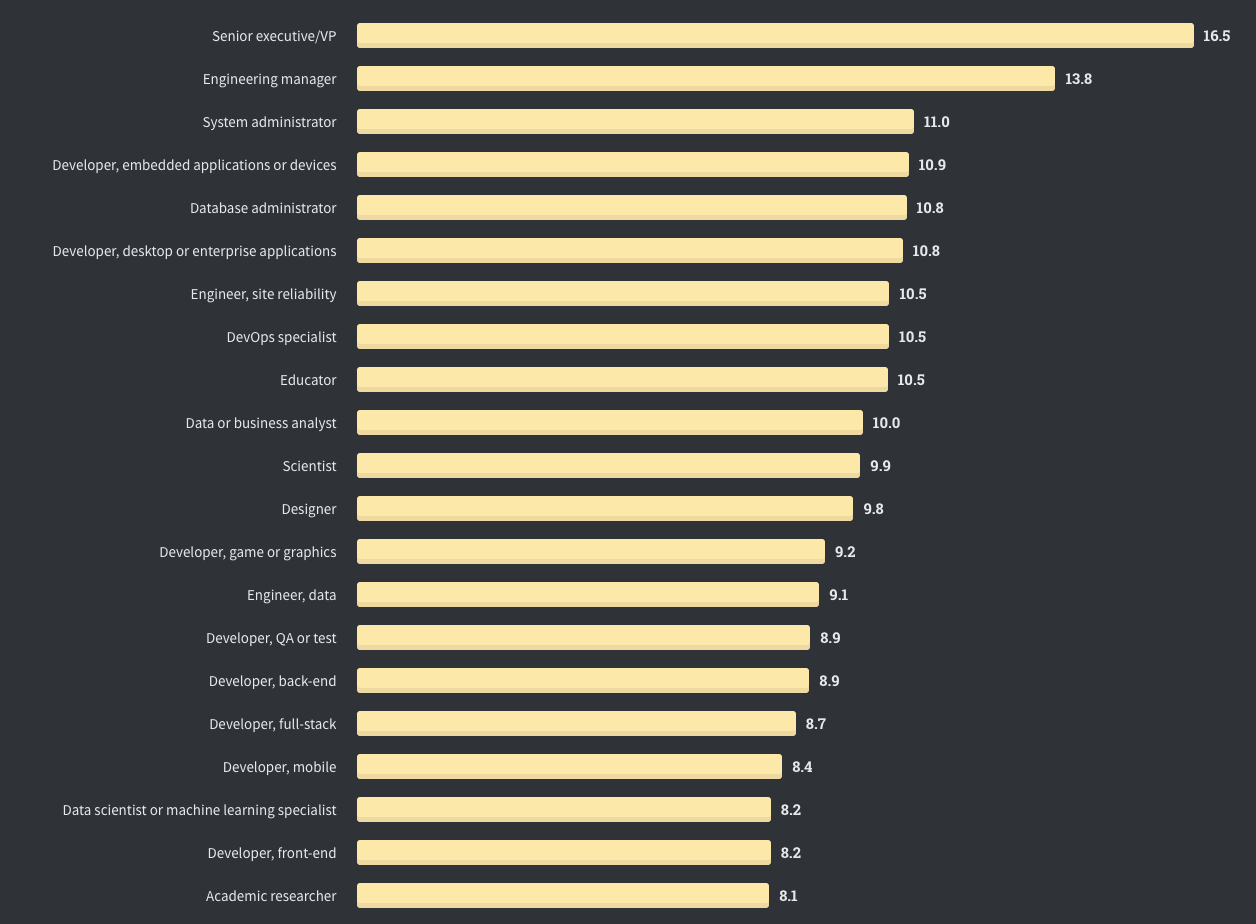
It’s also interesting to see that most managers and executives tend to have 14 years or more of coding experience.
It’s not a secret that today software development and tech in general is an employee’s market. Businesses are hungry for talent more than ever before and are offering handsome compensations to talented and experienced tech professionals willing to work for them.
What is the best place to look for truly promising opportunities? There are plenty of old traditional recruiting websites available online that are full of open positions to apply to. They do, however, have multiple considerable disadvantages such as long and confusing job application process, large number of fake or outdated jobs, etc.
We believe that today, in the era of automation, AI and other Industry 4.0 technologies, tech companies and employees need new, better solutions to find each other with minimum time and effort. And GRIT is a solution made with that idea in mind.
GRIT is a platform designed to help exceptional employers and employees in digital and technology fields to find each other with maximum efficiency and minimum effort.
We’ve got rid of the industry’s lengthy sign up processes and you can get on board GRIT’s unique platform with our 60 second sign up in 6 simple steps.
At GRIT, your profile is anonymous and it’s your experience that counts. Receive requests from companies to view your full profile.
The companies that request to see your profile at GRIT give you the salary upfront before you even start the process.
GRIT flips the traditional hiring model and companies apply to you instead. Try finding your dream job in digital and technology on GRIT today!

In this high-tech world, being a budding entrepreneur is tough. As per a 2020 study, 72% of entrepreneurs are affected by mental health problems directly or indirectly. But for them, success and better management of daily life is important. By meditating regularly, businessmen can improve their brain power and lower the fatigue in the most stressful situations. This helps them translate into a better entrepreneur.
Did you know there are tons of famous entrepreneurs across the globe that have considered meditation and got tons of advantages? In this article, we will discuss how entrepreneurs can benefit from meditation.
Below are the incredible perks of practicing meditation every day for the businessmen:
Meditation lowers contemplating thoughts by letting the individual focus on the present scenario instead of the past. Did you know meditation can increase attention just after only four days? So, by doing it regularly, tycoons can better concentrate on their important business works and meetings well.
Taking deep breaths allows the individuals to take more oxygen into the body. This boosts mental wellness and brain functioning. Meditation enhances the signals of connections in the brain. As per one study, it can boost the productivity of employees by 120%. So, by investing time daily in mediation, budding entrepreneurs can make a big difference in their productivity.
One of the biggest advantages of meditation is stress reduction. Stress is the main cause of deadly diseases. But meditation can keep them at bay by making the person less nervous and stressed. It has proven to cause changes in the brain. As per one study, it enhances the amygdala in the brain responsible for controlling fear and stress. So, by considering meditation, budding businessmen can stay relaxed and make wise decisions for their business.
Taking a good night sleep every night is important for the busy business tycoons to stay ahead of their competitors. Did you know meditation can lower the wake time of insomniacs by 50%? Meditation is also helpful in improving sleep quality as well as health and wellbeing. This allows the entrepreneurs to stay active all across the day.

By involving themselves and their employees in meditation, entrepreneurs can take their company to reach new heights. The meditation helps them get in a relaxed state that allows them to solve any problem and deal with stressful circumstances in a better way.
Meditation allows budding entrepreneurs to become more patient by inculcating a feeling of positivity and calm. This lets them accomplish their objectives more easily and cope with failures that occur their way patiently.
Another benefit of meditation for entrepreneurs is to reduce distractions at work. It helps the person get better control over their thoughts and emotions by managing cortical alpha rhythms. So, this makes the business tycoons are less likely to react impulsively in frustrating situations.
Meditation allows budding entrepreneurs to maintain a good balance between their personal and professional life. It helps them stay motivated and active. This, in turn, makes way for increased happiness in their life.
Meditation helps tycoons to enhance communication with colleagues, competitors, and workers. This allows them to gain more respect, a good image, and more positivity in return.
Mediation has proved to be of great importance for the success and health of the budding entrepreneur. Did you know that 76.2% of individuals do meditation for improving health? The biggest benefit is that entrepreneurs can do meditation from anywhere without the need for any equipment or any past experience. So, meditate for few minutes on a routine basis and watch out what positive changes in several days. The best the business owners can do is download a meditation app or join a mediation class today to enjoy tons of perks.

Caring for the mental wellbeing of your teams has never been more important.
Not sure how? Here are some tips to help you take care of your team.
In a recent global study by Qualtrics (see here), 40% of people said that their employer had not asked how they are doing since the pandemic began. 38% of people in this group were more likely to say their mental health had declined during this time. It is important to check in with your people. An easy way is to ask is “How are you today, out of ten?”. People are much more comfortable expressing how they are feeling about their mental health with a number out of ten.
We all know how to look after our physical health, but we are less knowledgeable about what drives our mental wellbeing. Sleep; exercise; stress management; social connections; helping others; nutrition; financial wellbeing; sense of purpose all drive our wellbeing. As employers, we can help employees gain this knowledge to better understand areas they may not be doing so well in.
As leaders of people, we can help create a culture that is conducive to promoting positive mental wellbeing. If leaders can demonstrate that they are prioritising their own mental wellbeing, then this gives permission and encouragement for others to follow suit. Sharing the fact that you have prioritised sleep, planned exercise, or taken time to connect with family is all great practice here.
During these uncertain times, regular authentic and open communications is so important. Leaders will not have all of the answers but providing reassurance where you can and being open and vulnerable about the challenges, they and the business faces is helpful. Good examples include the CEO’s of the Marriot Group and Air BnB.
Leaders will have a huge number of strategic priorities to focus on right now. It is highly likely that the businesses that come out of the pandemic with high levels of employee confidence and tryst will be the ones that treat their mental wellbeing as a strategic priority. Your people will remember how you made them feel.

Mid-year is always a great time to pause and take stock of what you have achieved. Your career is one area that’s essential to evaluate. Perhaps you’re just getting started in engineering and technology. Or maybe you’ve been at it for a few years or more, but you feel like your career has plateaued.
Here are some fantastic inspiration from technology professionals who made it. But we’re not talking about icons like Jeff Bezos, Jack Ma, and Bill Gates. These career tips from not-so-famous but established tech pros could reinvigorate your ambitions!

Jensen is Co-Founder of graphics-processor company Nvidia. He frequently finds time to inspire upcoming engineers and students. In this interview, Jensen says that problem-solving skills are essential for career growth. According to Jensen, “most of life is about smart problem solving,” and employers and investors constantly look for people who can provide innovative solutions. Jensen advises that you should:
If you already have a strong technology background, you have the tools for the task. Run towards, not from, problems. But, be ready to cultivate an ever-learning mindset.
In technology, you always have to keep learning. It’ll significantly leverage your career. You may not be the most qualified candidate for a job. But according to this report by Robert Half, employers in high-tech societies like Singapore grapple with this problem every day. Studies show that many are willing to take up less qualified candidates and train them up.
So, be a problem solver who’s also willing and eager to learn. Demonstrate it by doing the following:

Many people lose opportunities to grow their careers because they do not believe in themselves. It could be due to the environment, but it’s often a self-inflicted state that shackles one to mundane roles and mediocre output. Caecilia Chu, the founder of YouTrip, knows this very well and encourages anyone in technology to believe in themselves.
In this blog, she offers three pieces of advice for aspiring leaders in technology:
Train your brain towards positivity. Humans naturally incline towards negative thoughts, and that could slow you down. Instead, program your brain towards positive thoughts and emotions. Studies show that it broadens your view and improves your skills. Along with this, use your core strengths in your line of work. Make it your “zone of genius”.
Lisa Su, the CEO at AMD, puts it differently. In an interview with New York Times, she had the following to share, “Set high standards for yourself and those who work with you. Technology intertwines almost every aspect of a business. Think beyond technical issues, master the business, and establish your zone of genius. It’ll give you an upper hand in providing innovative solutions.”

Caecelia mentioned how vital it’s to have a reliable team to support you. But to have people on your side, you need to make authentic connections. Tan Hooi Ling, the Co-Founder of Grab, asserts the need to sharpen people skills in your career journey.
In this interview with Marie Claire, Hooi Ling points out that ambition should be accompanied by a great attitude and appreciation for culture and diversity. Technology professionals are notorious for lacking people skills. However, it’s hard to climb up the career ladder without these skills. If you already have a strong technology background, that’s great because it could be an excellent career springboard. However, also work on developing people and management skills. You need to know how to relate to your colleagues on a personal level. How do you do this?
In conclusion, the opportunity to climb the career ladder, especially in technology, is always open. But you have to take the necessary steps. Believe in yourself and pursue your dreams. Do not shy from problems, and learn to work with teams. Your career will soar to new levels.

Due to the increasing number of open positions and the widening talent gap, the international tech sector remains to be an employee’s market. Even though the number of open tech jobs took a hit in 2020 as a result of the Covid-19 pandemic, in 2021 hiring in this field is booming again.
According to a report by IT trade group CompTIA, just in the United States alone the tech sector has already added 60,900 new positions in 2021. The talent gap that experts have been talking about for almost a decade now, warning that the supply of new tech specialists won’t be able to keep up with the demand, remains a big challenge. According to Gartner’s Emerging Risks survey, shortage of qualified tech workers is one of the biggest concerns for business leaders across industries today.
When looking at this issue from the perspective of people already working in the industry, however, it looks a lot more like an opportunity rather than a challenge. If you’re a software developer or other kind of tech expert, possessing solid and relevant skills, today’s job market is abundant with opportunities like never before.
But just having required skills and knowledge often isn’t enough to seize them. You also need to be knowledgeable about things like where to look for the right job openings, how to make sure you’ll pass the interview (or interviews, both general and technical one), and how to negotiate about the salary and other work terms.
As when it comes to finding the right opportunities GRIT has got you covered, let’s talk about going through job interviews and negotiating the salary in tech.
Being successful on the tech jobs market is, of course, quite an extensive and multidimensional topic and we don’t want to oversimplify it. That being said, many people tend to make the same fundamental mistakes when looking for a job and negotiating with employers. Here are a few basic tips and recommendations on how to stay on top of this game if you work in tech.

The technology industry is transforming and changing faster than any other. One of the most important aspects of being able to find a good position in tech, go through the interview and receive the offer is knowing the market. Do the market research frequently in order to know what companies are hiring, which skills are in most demand and how much you can expect to be paid. One of the best ways to stay informed is to communicate with other people working in this field, both in real life and online on forums and online communities for tech experts.
Another tech-specific basic recommendation that shouldn’t be neglected is to never stop learning. Due to the same reason of the tech market being highly dynamic and ever-changing, most successful tech professionals are forced to keep learning all the time throughout their careers. Invest a certain amount of time each month in learning new skills and technologies that will be useful in your current job and/or will help you to achieve career advancement.
When it comes to specific positions, being knowledgeable and informed about this particular role and the value you are going to deliver to the company if hired is in many ways crucial to the success of salary negotiations. Learning about your competitors for the position also can be very important. A lot of this information you can learn on initial stages of negotiations by asking recruiters, HRs and interviewing managers the right questions.
A common mistake among many tech specialists would be to underestimate the importance of having strong soft skills for their career. We even had a separate piece on this particular issue published recently. According to a survey conducted by consulting firm West Monroe, 78% of HRs and recruiters said they have become more focused on finding tech professionals with strong soft skills over the last several years. 43% of HR professionals surveyed also said that technology roles are harder to fill because candidates lack strong soft skills. And 67% of HRs have withheld a job offer to an otherwise qualified technology candidate solely because of that candidate’s lack of soft skills.
It is also worth remembering, and reminding yourself on a regular basis, that salary is not the only thing you should be looking at when considering a job or a job offer. Many people tend to forget this and fixate on the numbers. Take factors such as additional benefits, workload, company culture, future growth possibilities, etc. in consideration as well.
Salary may be not the only thing that matters in a job, but it is undeniably very important. Here are a few quick tips on how to conduct salary negotiations from a tech employee’s perspective.

Talking about tech interview preparation, here are a few online platforms that you can use to train and practice.
GRIT is a platform designed to help exceptional employers and employees in digital and technology fields to find each other with maximum efficiency and minimum effort. But what makes GRIT unique?
Try finding your dream job in digital and technology on GRIT today!

The term ‘soft skills’ has been thrown around a lot in the tech industry in the last several years. Tech business leaders and high-profile managers increasingly emphasise the importance of having well-developed soft skills for every team member regardless of their specialisation in order for a company to be successful.
Of course, having a strong set of technical skills is still determinative for tech professionals, but today the industry also recognises that neglecting the importance of soft skills can have a considerable negative impact on productivity and overall results. If you look at this from an employee’s point of view, many tend to underestimate the importance of soft skills or their role in career development, while others have a somewhat fragmented understanding of what soft skills really are.
This is why today we would like to dive deeper into this topic, and talk about soft skills and their place in the modern-day tech industry.
We probably should begin with clarifying what exactly is meant by ‘soft skills.’ Wikipedia defines soft skills as a “combination of people skills, social skills, communication skills, character or personality traits, attitudes, mindsets, career attributes, social intelligence and emotional intelligence quotients” that enable people to communicate well with others and comfortably navigate their working environment.
To put it in simpler terms, soft skills are all about interaction with other people at work, including communication, collaboration, the ability to resolve conflicts and other components of working as part of a team.
According to a survey conducted by consulting firm West Monroe, 78% of HRs and recruiters said they have become more focused on finding tech professionals with strong soft skills over the last several years. 43% of HR professionals surveyed also said that technology roles are harder to fill because candidates lack strong soft skills. And 67% of HRs have withheld a job offer to an otherwise qualified technology candidate solely because of that candidate’s lack of soft skills.

Collaboration-based issues between business people and technology specialists are not uncommon, the research shows. The most common reasons these issues arise are verbal miscommunication (cited by 62% of people surveyed), poor teamwork (44%) and written miscommunication (38%).
Consequences of collaboration-based issues can be quite serious. Most often it’s delayed or prolonged projects (cited by 71% of people surveyed), lower overall quality of work (43%), and missed deadlines (33%).
There are multiple other reports highlighting the increasing importance of soft skills for tech specialists. According to a recent IT Trends Report 2020 by SolarWinds, public sector IT professionals in the United Kingdom increasingly point towards key non-technical skills as most critical to successfully managing today’s complex IT environments. LinkedIn’s 2020 Emerging Jobs Report also highlights rising demand for specific soft skills, alongside other areas such as creativity, in today’s job market.
It should be evident by now that soft skills do play an important role in today’s working environment and should be considered by tech professionals seriously. Here are some of the soft skills that tech employees and other professionals working in the industry consider to be the most crucial.
Communication is commonly cited as the most important soft skill of all, as tech experts need to constantly communicate with their teammates, supervisors, clients and other people to be able to perform their job well.
For all the reasons stated above, collaboration skills are of the most importance as well. Collaboration is all about your ability to work as part of a team, exchange information with peers and colleagues, delegate tasks and so on.
Being self-organised is a very common requirement in the tech industry as well, as it allows employees to work more effectively and be more productive. Organisation skill includes the ability to plan your work, prioritise tasks, manage working time and so on.

Creativity doesn’t get mentioned frequently in job descriptions as a required skill, but it is certainly a very desirable quality for a tech professional to have. Tech work often involves the need to solve complex problems and being creative can be very helpful in finding non-trivial solutions.
Conflicts in one form or another happen in all organisations. Conflicts can arise between team members, with clients or higher management. This is why tech professionals need to know how to be diplomatic, resolving conflicts at the very beginning and not letting them grow into something serious.
Being able to take the responsibility for your work and decisions, including potential mistakes, is a very important component of successful team collaboration as well. People who have low accountability skills, on the other hand, tend to be not very good in collaboration with their teammates and other coworkers.
Emotional intelligence is a capability to recognise and manage emotions, both your own and those of others. Employees with high EQ are able to deal with stress, know how not to lose temper, and are able to manage difficult situations calmly and effectively. So it’s no wonder that emotional intelligence is considered to be among the most important soft skills for tech workers.
Of course, you should remember that soft skills are obtainable through learning and practice just like any other skills. And understanding all the benefits of having strong soft skills should push your desire to improve them. So let us give you a few recommendations on how to do that.
As communication is a skill, you develop it through practice, so just increase your communication with colleagues and try to get better in the process.
Being open to feedback you are receiving from coworkers and supervisors is one of the best ways to get constructive information about everything related to your work, soft skills included.

Listening is a part of communication that can be trickier in day-to-day routine than it seems. Good listeners know how to receive information by paying attention to what others are saying or trying to say.
Any organisation is a selection of individuals, this is why building personal relationships with colleagues has an effect on the collective dynamics. Make an effort to know more about people you are working with by casually talking on general topics not related to work.
You can learn a lot and improve your soft skills simply by watching others. Observe the way your coworkers interact with each other, communicate and react to work-related issues.
Today the jobs market for software developers and other tech experts is full of opportunities more than ever before. Are you ready to seize yours?
GRIT is a platform designed to help exceptional employers and employees in digital and technology fields to find each other with maximum efficiency and minimum effort. So, what makes GRIT unique?
We’ve got rid of the industry’s lengthy sign up processes and you can get on board GRIT’s unique platform with our 60 second sign up in 6 simple steps.
At GRIT, your profile is anonymous and it’s your experience that counts. Receive requests from companies to view your full profile.
The companies that request to see your profile at GRIT give you the salary upfront before you even start the process.
GRIT flips the traditional hiring model and companies apply to you instead. Try finding your dream job in the digital and technology industries on GRIT today!

As we are witnessing considerable economic challenges all around the globe, caused by the Covid-19 epidemic, the technology industry seems to be almost completely unaffected by all this turbulence. In fact, the opposite is true: some niches of the tech market rocketed over the last year, while the demand for high-qualified tech professionals has increased.
And it will keep growing in the coming years, causing considerable shortages on the job market. According to Statista, there are around 24 million software developers in the world today, and by 2024 this number will grow to 28.7 million. But even this won’t be enough to satisfy all the demand as analysts expect the number of tech-related jobs to grow by 37% in 2022 alone. This means that the demand for programmers and other software development experts will considerably outpace the supply. Which makes a great employee’s market.
For professional software developers, it’s crucial to have a relevant skill set that will meet current requirements on the market. But the rapid growth and continuous transformation of the tech industry has its downsides. It can be quite difficult even for experienced software developers, let alone beginners, to navigate this ever-changing market with new technology stacks, trends and solutions constantly replacing each other.
This is why today we would like to talk about the programming skills that are most in-demand on the job market today, in 2021.
Of course, it isn’t always obvious when it comes to the software development industry what is meant by “the skills,” as there are multiple programming languages, specialisations, tech stacks and so on. We are going to look at the technologies and specialisations in programming that are the most demanded by employers today, as well as high-paying and experiencing a considerable workforce supply shortage at the same time.
But first, some interesting data! Our analysis, based on several reports done by reputable research companies, allows us to specify these ten tech positions as the ones in highest demand in today’s market:

And the following ten technologies are considered to be the most in-demand expertise:
Based on a number of analytical reports and studies, such as the one referenced above, we have concluded this list of five programming skills/specialisations that in our opinion are the most in-demand by companies across various industries today.
As AI/ML technologies keep evolving and finding more and more applications in real life, the number of jobs in this niche and the demand for AI/ML-related skills is skyrocketing. In fact, according to a recent study by Burning Glass Technologies, IT Automation and AI/ML are the two highest paying jobs in tech in 2021.
As the integration of AI and ML technologies can have a game-changing effect on businesses, companies in various industries are rushing to adopt it. But the highest demand for AI/ML specialists is observed in these industries:
According to Salary.com, the average AI Engineer salary in the U.S. currently is $140,306, with the range typically falling between $134,466 and $150,491. In Singapore, the average AI Engineer salary is $6,602 per month.
The salary data for other Southeast Asian countries is mostly insufficient (this is why hereinafter we will specify only the Singapore data), but it’s safe to say that the level of compensation for all positions in this list throughout the Southeast Asia remains consistently high, in line with general global demand for specialists of these profiles and universal applicability of these skills regardless of the world region.
And here are five of the most frequently required skills for AI/ML positions (based on our own analysis):

It should come as no surprise that along with rising popularity of online platforms and cloud solutions came increasing demand for cybersecurity solutions able to protect businesses and individual users from various threats, such as information leaks and hacker attacks.
As a result, the demand for cybersecurity experts is quite steady across multiple industries, but here are four that are hunting programming specialists in this field most actively:
According to PayScale, the average salary for Information Systems Security Professionals in the U.S. is $115,978 per year, and it can go up as high as $173,000 per year. The average salary for a Cyber Security Engineer in Singapore is SGD 120,237 (around US$90,000) a year. When it comes to specific skills and expertise, here are five most frequently mentioned ones:
As the software development market is growing, the competition is rising and so are the requirements for the efficiency of the development cycles and product delivery speed. This is why there’s a considerable demand for DevOps specialisation. According to a report by Research Dive, the global DevOps market will grow by 22.9% every year from 2020 to 2027.
Of course, software development is the main industry hiring DevOps engineers, but the demand for specialists with this expertise is also high among businesses in other industries that develop software products to support their operations. Such industries would be:
According to Glassdoor, the average salary for DevOps Engineers in the U.S. is $102,378 per year. In Singapore, a senior DevOps Engineer can expect an average salary of $119,998 per year ($67,713 a year for entry-level positions). And five most frequently mentioned skills in DevOps job openings are:

Big Data is another major technology trend that’s being rapidly adopted by businesses in various industries. According to Statista, the global Big Data market is projected to grow from $5.3 billion in 2018 to $19.4 billion in 2026. When it comes to specific industries, same as with AI/ML, the adoption of Big Data is spreading quickly, but these four are the biggest employers for Big Data programming experts today:
According to Glassdoor, the average salary for a Big Data Engineer in the U.S. $102,465 per year, In Singapore, $6,378 per month is the average salary for Big Data Engineers. As for the specific skills required, the following five are mentioned by employers most frequently:
Mobile development is probably a more obvious trend, as today there are almost 4 billion smartphone users in the world, and businesses that want to stay relevant and competitive in this market need fully functional mobile applications.
This keeps the demand for qualified mobile developers high and it will increase, with these industries as the most active employers:
According to Indeed, the average salary for a Mobile Developer in the U.S. is $117,462 per year. And an average Mobile Developer in Singapore would earns $5,787 per month.
When it comes to required skills, they can vary depending on the platform, as the majority of mobile applications are developed for two most mobile operating systems: Android and iOS. But these five skills are the most frequently mentioned as required in job openings:
Evidently, today the jobs market for programmers and other software development experts is full of opportunities more than ever before. Are you ready to seize yours?
GRIT is a platform that’s designed to help exceptional employers and employees in digital and technology fields to find each other with maximum efficiency and minimum effort. So, what makes GRIT unique?