

No matter how large or small an organisation is, without proper leadership and direction, the entire operation can be meaningless. A company must have consciousness and conscience to function properly. It must be led in the right direction by someone who can propel it forward on its path to success. That’s where good managers come in: They lead organisations that require steering, rather than simply following.
However, many businesses around the world are still struggling to engage their employees through high-quality leadership. Gallup discovered that 82% of the time, companies fail to select the candidate with the talent for the job.
This could be a problem because, for an organisation to succeed, a manager must not only be present but also be in charge of the company’s direction. While that may appear to be common sense, that kind of thinking doesn’t hold up to scrutiny when there are too many people occupying too few seats at the top.
It’s important to note that managers have the most direct impact on the employees under their supervision. They’re accountable for ensuring that the performance of their department and its employees are in line with the overall organisational goals while also defining the workplace culture.
Hence, the responsibility of leading the actions of their collaborators comes from the role of managers and leaders. With a proper understanding of what their jobs entail such as delegating, planning manpower distribution, making decisions on time, and motivating employees from time to time, good managers can really help to boost productivity levels among workers.
Workforce productivity, also known as labour productivity, is defined as “real economic output per labour hour” by Investopedia. The change in economic output per labour hour over a specified period is used to calculate workforce productivity growth.
Workforce productivity is an important measure of how efficiently a company or country uses labour to produce goods or services. It’s an indicator used by economists and financial analysts to measure the size and strength of the economy, as well as a key benchmark for companies’ competitiveness in the global economy.

Any effective and successful business must recognise the significance of workplace productivity. Productivity benefits both employees and employers, by assisting the firm in increasing and utilising the maximum capacity of its human resources.
Many factors influence worker productivity, not just management techniques, but they’re difficult to measure or predict accurately. The most crucial component is a country’s overall economic health, which influences job growth, government policies, and how much businesses invest in their operations.
It stands to reason that a decline will result in a decrease in profitability and, in the worst-case scenario, the organisation’s demise if not corrected. While we all want competent managers and leaders who can effectively delegate and help drive the company to the top, there are advantages and disadvantages to this implementation as the world continues to create a more productive working environment.
1) More income/ revenue
Many organisations are constantly striving to increase workplace productivity because it generates more revenue with the same amount of input and cost, resulting in higher profits. The financial benefits open up even more possibilities for the business, such as expansion or the purchase of additional resources. Your company will thrive and succeed in the long run if your employees increase their productivity and generate more revenue.
2) Clarity
Workforce productivity and purpose go hand-in-hand. When your employees are productive, they’re focused on achieving their goal, which is ultimately the goal of your company. They have a clear objective and know what they need to accomplish by the end of the day or week. They also have a better understanding of their overall purpose and why they do what they do.
3) Quality work
With clarity, employees can be more effective and produce better output. Producing better results not only benefits the organisation you’re managing but also gives you a sense of satisfaction and accomplishment as an individual. This will boost your and your team’s confidence, which will feel great!
4) Productivity breeds positivity
When you’re being productive, it’s almost certain that you’ll bring positivity into everything you do. Being productive as a worker means earning money to support yourself and your family, whereas being productive as an employer means providing resources to your employees. Essentially, productivity provides.

1) Continued expectation
So, now that you’ve named your favourite employee the employee of the month after he or she has worked 80 hours per week, you’re continuing to expect greater and better things of him or her, which may turn out to be detrimental.
Everything appears to be fine until this employee of yours becomes burned out and decides to take a step back and stops working after office hours. You’re now panicking that you might lose your best employee and that your company will implode. With one wrong move, you could lose this employee once and for all.
2) Different types of employees
Unfortunately, productivity is not a one-size-fits-all model, and your strategies may not work for some of your employees. Some members of your team may be more self-disciplined than others. For example, you could implement Strategy A for all of your employees in the hopes of increasing productivity.
The procrastinator on your team may produce good results, but he or she cannot keep up with the rest of the team members who are producing more output in the same amount of time. This will reduce the overall productivity of the team. In the long run, your organisation will suffer as a result of the vicious cycle.
3) Counter-productive
You may believe that the various technologies developed for employers to track employees’ activities will help to improve your organisation’s productivity. Apps and software that are used to monitor progress or keep employees in check are now emerging one after the other.
However, research has found that this has been counter-productive because it creates anxiety and uncertainty for employees, leaving them feeling suffocated and untrustworthy. You could also be affected because routinely checking in on employees may give the impression of productivity when, in reality, they’re just distractions from the actual production process.
It’s critical for you, as a manager or supervisor, to devise strategies to boost your company’s productivity. So here are some pointers to assist your subordinates in being more productive at work.

When it comes to promoting work productivity, comfort should always come first because a comfortable workspace creates a positive vibe. Invest in ergonomic furniture that not only looks good but also feels good for your employees to sit on for long hours.
Add different colours to connect with your employees’ emotions at work. Blue and green hues can boost productivity and focus, while yellow can stimulate creativity and help your team come up with better ideas. When it comes to layout, consider having open space with some designated private areas where your employees can move around and use rooms as needed.
Despite cultural notions that playing games at work hamper productivity, the truth is quite the opposite. In fact, games and other leisure activities among workers (and bosses!) can help to create a better working environment.
Some friendly ping-pong matches with the Heads Up can strengthen bonds between employees or an organisation. Allowing employees to take a break may also help to refresh their minds and reduce absenteeism. After all, as the saying goes “all work and no play makes Jack a dull boy”!
Creativity vs. productivity: One is subjective and unpredictable, while the other is structured and linked to performance metrics. However, research shows that they both work in tandem with one another. To put it another way, creativity fuels productivity.
When your employees are fuelled by innovative thinking and are involved in a culture of experimentation in which you, as the manager, invest the company’s time and effort into this ideation, the results are usually fruitful and convert into profit.
Some activities that can help you foster creativity include team brainstorming sessions where no idea is wrong! If your employees are more reserved, consider allowing anonymous suggestions that you can go through, and act on good ideas regularly.

It’s one thing to be able to catch some fun time at the office with your colleagues, but sometimes, your workers need some alone time to themselves. A refreshing, small, but frequent allowance for a break can help your employees to have a respite from the monotony and boost their focus from time to time. Even a short walk around the lobby or taking a mini nap can do wonders to your employees’ productivity.
The benefit of working in an office is that everyone is in the same building and is reachable via intercom or a knock on their door, removing the need for you to be constantly engaged on your smartphones and tablets. With constant connectivity on multiple screens grabbing our attention at times, it can be a great distraction for us to work productively.
Prepare a “gadgets home,” such as an individual box, for your employees, or implement a no-phone-on-desk policy for every hour or so while they’re at work. You’ll notice that your employees will be more focused on the task at hand, increasing the business productivity altogether.
One cannot simply avoid using the Internet during working hours because it’s a necessary tool for their jobs. This includes various Internet-connected devices and the various apps that come with them. ‘Push Notifications’, which enable the delivery of targeted information from an app to a mobile device or desktop computer without a specific request from the app, can be distracting and take focus away from the actual task at hand for your employees.
According to research, minor distractions can have a significant impact on your workers’ productivity. To reduce the possibility of this happening, workplaces are now using Internet-blocking apps. Apps such as Cold Turkey allow you to block specific websites or apps for varying periods, allowing your employees to focus on their work without distraction.
It’s common for staff to feel comfortable and complacent after working for a while, which could be detrimental to workplace productivity. As managers, you should create new challenges on a regular basis to ethically motivate, encourage, reward, and recognise your fellow employees. For example, you could try seeking employee input regularly on ideas and decisions so you can maximise their full potential.

Did you know that most employees dread meetings? Especially the ones that could’ve been an email! Consider employees who have just walked into the office, ready to get to work. All of the sudden, they’re summoned to a meeting in which they can’t fully participate or have any say. Just like that, an hour of their office time has been wasted, and your employees must now take the time to shift into fourth gear and be even more productive at work.
To avoid this, double-check the invitee list before organising a meeting to ensure that everyone on the list is relevant to the event. You can also ask for feedback from the staff at the end of each meeting to see what could be improved. Together, you and your employees can focus on enhancing the processes that take place at your workplace, and automatically create a more productive business.
Iit’s tempting to recruit every “yes” person in the world, just because you think they’ll perform more work for less money, or simply say yes to whatever you need. Just keep in mind that this could have a very negative impact on your workplace productivity. So, are you considering delegating any low-priority work to your employee during a busy period? Give them room to say “no”.
This helps them to concentrate on the most vital tasks at hand, resulting in higher output and increased productivity for your company. You should also allow your employees to say no to responding to messages at any time of day or night, allowing them to maintain a good work-life balance. Happier workforce, better production!
Healthy employees are happy employees. And happy employees are keys to your business productivity. Research done by Oxford University’s Saïd Business School found that happy employees are 13% more productive.
If your employees are overworked and unable to enjoy life outside of work, they’re less likely to be happy because there is no work-life balance. Workers who have the opportunity to exercise a healthy work-life balance are more productive and motivated at work. That’s exactly what you’ll need to boost your company’s performance.

If you’ve heard that some of the world’s largest corporations are providing their employees with funds to set up a dedicated working space at home, you’re not mistaken. This is due to research indicating that a proper working environment at home is essential for your employees’ productivity.
Consider investing a small amount to compensate your employee for setting up their work desk at home if you’re a business owner. Alternatively, you could hold a competition for the best “My home office.” It’ll be a fun way to encourage your employees to neatly arrange their workstations as they compete to win a prize.
As a manager, it’s your responsibility to assist your employees in getting the appropriate tools to help them perform better at their jobs, thereby benefiting your organisation in the long run. The Pomodoro technique, for example, is introduced to help reduce distraction while your staff is working on a task. Try demonstrating the technique to your employees and checking in once awhile to see how effective it is.
Many managers struggle with this, especially when it comes to workforce productivity. They worry because working remotely is still a change of habit from what’s been practiced for hundreds of years. However, for your employees to grow, you should try to trust them rather than suffocate them with micromanagement and checking in every few minutes.
Implement some strategies that will allow you to supervise your employee without having to monitor their every move. Encourage your employees to be transparent about their progress and to come to you for advice or assistance. In this manner, you’ll enable your team to grow and improve their productivity levels, thereby increasing the overall productivity of your business.
Leaders who take into consideration the working hours needed for employees to perform structured work (“clear, specific tasks that are expected to be done in a certain order, at a certain time”) and unstructured work (“day-to-day tasks that keep the organisation running such as meetings and responding to emails”) can increase productivity and ingenuity.
According to the Workfront 2019 State of Work Report: “While 64% of workers say their workplace regularly asks employees to think of how they can do things in a completely new way, 58% say they’re so swamped with day-to-day work that they don’t have time to think beyond their daily to-do list.” So, strike a balance between the two structured and unstructured work to boost productivity, by allowing time for collaboration and setting clear expectations.
With so many changes taking place in the world that are challenging traditional ways of doing things, we must always strive to work smarter rather than harder. As a leader and manager of a group of people within an organisation, you should take the lead in developing better workplace practises, not only for the benefit of the company and business productivity but also for the benefit of your employees.
Thanks to advances in innovation and technology, employers and employees can now communicate via a variety of channels, each with its own set of features. They can help you organise projects, track the progress of your employees, and collaborate with your team all in one application or software.
Some of the apps that employees and managers can use to collaborate and become a more productive team are:

Regardless of the industry, attracting and retaining the right talent is critical to ensuring business performance and success. A study of individual performance from various sectors, including entertainers, athletes, researchers, and politicians, discovered that high performers can be 400% more productive than average ones.
Nonetheless, one of the most serious issues confronting many businesses around the world is the retention of key employees. We now live in a fast-paced world where any job market is as competitive as it has ever been. Job hopping (where an individual holds multiple positions in less than two years), which was once considered a negative trait on resumes, is now fairly common.
This is more pronounced now, as businesses try to recover from the Covid-19 crisis, and are willing to engage in employee poaching (i.e., hiring the current or former employees from a competitor or similar company). This means that your employees have options to explore, other than only working for you. So, if you can’t keep your employees engaged, they’ll likely leave for other companies that offer better benefits, or even go the self-employed route.
It’s no surprise that employee turnover and attrition rates are now higher; a major factor of this has been the anxiety brought on by Covid-19, whether it’s the stress of working from home, or the overall turn of the world’s economy. There’s even a phenomenon known as the ‘Great Resignation’ or the ‘Big Quit’, which is prompted by the pandemic as the workforce realises that having a job is not the only way to earn money, nor is it worth the stress of it all.
The U.S Bureau of Labor Statistics recorded 4.25 million people who resigned in January 2022, an increase from the previous January’s 3.3 million, with more than 40% of workers actively seeking or planning to seek new employment. A survey of knowledge workers around the world discovered that, on average, more than half of them are looking for a new job within the next year. According to a survey conducted in the United Kingdom and Ireland, 38% intend to quit within the next 6 to 12 months.
Generation-wise, the EY survey found that Baby Boomers or those with more than a 10-year tenure at a company, are more likely to stay, as compared to millennials who are likely to quit by more than twofold! Furthermore, resignation rates are higher among those aged 30 to 45 years old.
Employees who are skilled and talented are valuable assets to any organisation. Businesses can maximise productivity, increase profitability, and even save money in the long run by utilising these skills.
Of course, with competition amongst companies to hire the best intensifying in all major industries, finding the right person is no easy task. However, once talented employees are hired, it’s equally important to retain them. So, as employers, what can you do to ensure talent retention?
Employees rarely leave a company for no apparent reason. Most of the time, they must be dissatisfied with something, or have discovered a better opportunity. To retain good fits, it’s highly imperative to understand the reasons they may leave.
According to a study conducted by Personio and Opinium, toxic cultures and underappreciation are two of the most common reasons employees consider leaving their jobs. Work-life balance and pay freeze or cuts are also some of the main reasons prompting resignations.
Read more: High Employee Turnover: 10 Toxic Workplace Issues That Cause It, And How To Manage Them
This would then come down to how well you connect with your workforce. Some of the things you can do to identify and track employee turnover are as follows:
It’s also important that you determine each employee’s appreciation criteria and understand other intrinsic and extrinsic motivations such as career growth, decision-making opportunities, recognition, and feedback to retain talented employees.

Why you hire new employees into the organisation in the first place matters when it comes to retaining employees. To avoid wasting resources and having someone who’s not positioned to succeed with the company, hire and retain the right people.
Hiring the wrong people for the job can result in up to 70% more time spent dealing with a poor performer in a team, as well as up to 25% (or more) of the annual salary set for the role for the hiring process to be repeated. Furthermore, the consequences of a bad hire can include a disruption in company culture, reduced work output, and potential customer and revenue loss.
The pandemic has opened discussions about the possibility of working from home, either fully or in a hybrid with on-site work. Offering scheduling or workplace flexibility would increase the likelihood of employee retention. It also increases engagement, and talents are seen to be more enthusiastic with better physical health – which naturally improves overall profitability.
Having been given this flexibility, employees can gain better work-life balance. The Gartner 2021 Digital Worker Experience Survey found that up to 43% of workers report being more productive with flexible working hours. Working remotely also allows employees to work up to 1.4 more days per month (or 16.8 more days per year) than office workers, according to a survey conducted by Airtasker.
Employees who can go to work and be passionate about the work they do are more likely to stay. In a study conducted by Millennial Branding and Beyond.com, 30% of workers cited salary as the most important benefit they considered when choosing an employer, while 30% cited meaningful work. This placed meaningful work and pay on an equal footing.
When employees feel engaged, they find meaning at work and are willing to work hard while they are on the job. This is as per a Harvard Business Review which stated, “people at work are more likely to thrive and grow when they experience their job as meaningful.”
Furthermore, according to the Deloitte Talent 2020 Report, 72% of respondents who planned to stay with their current employers felt that their skill sets were valued. In contrast, 42% of participants who intended to change jobs stated that their employers were not utilising their skills effectively.

Who enjoys being managed and bossed around by inept managers or supervisors? Yes, we thought so, no one does! Bosses play an important role in any workplace, and poor ones can directly cause employee turnover and ruin a company’s prospects.
People in positions of authority must be aware of what is going on in the ranks below, and how superiors treat their subordinates. Consider this: LinkedIn shared a study in which men who reported having bosses they didn’t respect were 60% more likely to suffer a heart attack or another life-threatening cardiac condition!
So, never dismiss signs of bad governance in your organisation if you want your top talent to stay. According to a GoodHire report, (82%) of American workers said they might quit their job because of a bad manager. This demonstrates how poor management can result in low employee retention.
Exposing employees to relevant and consistent training not only improves their knowledge and skills but also helps enhance the company’s performance and outcomes. When you provide opportunities for employees to advance and become more effective and/or skilled, they’ll appreciate it, and are more likely to remain loyal.
A survey conducted by the Society for Human Resource Management (SHRM) found that nearly 70% of people who go through good onboarding programmes stay with their employers for more than three years. Through training, workers gain a path to continued growth, and the confidence to handle any task given to them.
Simultaneously, many employees are more willing to stay if they believe there’s room for promotion and advancement. Make sure to determine which types of training are appropriate for your employees and make frequent announcements about training possibilities to keep them motivated.
Remember that no employee walks into a job knowing exactly what is expected of them. There must be some things they have yet to learn or be made aware of. That’s why it is critical to consider how you provide feedback/criticism to them for them to improve.
When providing feedback, be specific and positive so that workers are encouraged to do better and give their best effort. Additionally, provide specific examples and actionable suggestions for progressive change, allowing problems to be resolved quickly and easily without hurting anyone’s feelings.
When you have negative comments to make in the future, try to restrain yourself and see if you can positively say them, or combine them with more positive comments to create a balance. Most importantly, reach out to your employees to make them feel welcome and free to express themselves.

Employers must promote employee mental health at work if they want to attract and retain committed employees. According to a recent survey conducted by Modern Health and Forrester Consulting, 73% of employees said they would be more likely to stay at a company that provided high-quality mental health resources.
This is evident when a pandemic strikes, and organisations are required to look after the mental health of all employees. If your employees believe that the mental health benefits provided do not meet their needs, there’s a good chance that they will leave for something better.
Focusing on employees who work remotely is especially important because they tend to juggle work, home chores, and family responsibilities. This resulted in working outside of designated work hours, which could lead to job burnout. Always check in on your employees, especially if you know they’re going through a difficult time.
According to Lattice’s SOPS report, the number one driver of employee turnover is compensation, with more than half (55%) of employees leaving for jobs with higher pay.
This demonstrates that competitive compensation should be a top priority if you want to keep your employees engaged in their jobs. If your employees believe they are not being compensated adequately for their efforts, they will become dissatisfied with their jobs and seek employment elsewhere.
Conduct the necessary research, and work to ensure that your employees are fairly compensated. Concurrently, communicate your compensation strategy so that your workers understand how decisions are made. This will make them feel more connected to the organisation, giving them a reason to stay.

The overall support and welfare systems in place for employees are one of the more talked about aspects of working and work culture. Mentorship programmes, for example, can help new employees with questions, and confusion about tasks and roles.
Another factor to consider when it comes to talent retention is personalised employee support. By assuring that employees are taken care of across the board with the assistance they may require, they’re able to stay at their post for longer. Providing personalised support can increase employee loyalty to the company by up to 40%.
Workers will feel valued and respected that the company prioritises their interests as well as their productivity by catering to this as part of employee welfare. This will naturally build loyalty and consequently reduce the employee turnover rate.
According to PWC’s Future of Customer Experience Report, one in three customers will leave a brand they love after just one bad experience, while 92% would completely abandon a company after two or three negative interactions.” This emphasises the importance of ensuring that your workplace culture and environment are conducive to employee happiness.
Embracing employee happiness can help retain talent while preventing unwanted turnover. Make them feel valued and respected by learning about their personalities, soliciting feedback, establishing trust, and providing recognition, among other things.
Now that you’re aware of all of these strategies, which do you believe would be most effective in assisting your company in retaining its employees? Some businesses are already taking advantage of this to ensure that they do not lose quality and invested employees who are valuable to them.

There are numerous advantages to retaining skilled and invested employees for both businesses and the workforce. Giving employees assurance and a sense of security through motivations, whether extrinsic or intrinsic, is the nutshell factor that helps them stay with a company.
This means a company must keep its employees engaged to achieve maximum success and growth. Understanding employees, their needs and capabilities, and working together to reach goals (personal and for the organisation) are some ways that companies can do to reduce attritions.
Well-supported employees, on the other hand, can develop loyalty, enthusiasm, and energy, which will increase productivity. Losses can also be minimised in the long run. Mishaps and resource loss are significantly reduced when employees work together for the betterment of the company.
Especially in the aftermath of a pandemic, where the very structure of ‘working’ and ‘being employed’ has shifted. Employers must conduct in-depth analysis to determine the best ways to retain talented employees.

Working from the office is so old school! The new trend is now working from literally anywhere. And we have the Covid-19 pandemic to thank for expediting the growth of remote working (we’re in no way overlooking the sufferings it brought, but we also can’t deny the good things that came out of it, right?).
Yes, the pandemic had been a trying time for us all, but with time, we’ve been able to get back on our feet! We were all forced into our homes for extended( and numerous) periods of time, having to carry on with our jobs through remote working.
For those who always grumbled about waking up in the mornings and travelling to the office, remote working was a welcome relief for many. But for others, remote working was boring, having to stare at screens instead of getting to meet colleagues to share stories or giving them a hearty high-five for a job well done.
It was the same for employers. While some readily accepted the changes, some were pretty reluctant about letting employees work from home. Whichever team you belonged to, you have to accept that remote working is here to stay. There are no two ways about it!
So, why not take full advantage of this ‘new normal’ way of working? Let us tell you how!
Remote working is widely understood as a professional setup where employees are allowed to work outside of the conventional workplace or office environment.
Isn’t it obvious why it’s such a craze among some workers?
For one thing, working from home allows an employee to perform their tasks and achieve their professional goals without having to commute to the workplace regularly.

Remote working has remained a viable professional concept ever since the invention of digital technology. Also known as ‘telecommuting’, remote working was first coined as a concept by Jack Nilles, a NASA engineer.
With the turn of the millennium, companies like IBM had started experimenting with work from home and allowed workers in limited numbers to pursue it to test its effectiveness. With the rising popularity of garage startups and call centres, more employees would engage in remote working, leading to its growth over the subsequent years.
Before the pandemic, this practice was offered as a benefit to certain employees, and adopted by select companies and businesses. However, Covid-19 made it mandatory for all employees in almost all sectors to work remotely from home, and some businesses that never even dreamed of remote working had to adopt it almost overnight. Phew!
With Covid-19 cases rising across the world in the latter half of 2019, this practice was proposed by several companies as a viable alternative to commuting to the office every day. By 2020, the pandemic had made it mandatory for most offices to carry out their objectives from home over virtual modes of communication. Several businesses continue to this day, even in the post-pandemic era, since employees are now demanding such flexibility. You’ve probably heard about the ‘Great Resignation’, and know all about how demand for remote working is one of the major drivers.
Unlike the work from the home condition that was mandatorily implemented to restrict the transmission of the virus, the benefit version of work from home has always remained a favourable strategy for most businesses. It allowed companies to employ workers without having to think of rising overhead charges, and opened up new avenues for businesses to discover hidden talent without restrictions like distance.
So, there you go, by offering remote working, you not just win employee loyalty, but can benefit you in several ways too. Let’s find out how.
Some of the reasons remote work has become popular for businesses across the globe are:

One of the primary reasons behind the growing popularity of work from home is the flexibility of work hours it comes with. Remote working gets rid of limitations like fixed work hours, allowing employees to follow a flexible work schedule, while companies were able to recruit talent beyond country borders and time zones.
Employees now get to work remotely from the comfort of their homes without having to commute to work on a regular basis. This has been helpful in streamlining their time management, saving time due to the absence of having to commute to the office daily. Employees can attend to their families and personal activities in the time saved, helping them to strike a proper work-life balance.
How does it concern you, you ask? Reduced employee attrition is the answer! If your employees are happy, they will continue staying with you. And, every business knows the struggle, risk, and cost of losing existing employees and hiring plus training new employees.
According to a report published in the Business News Daily, remote working significantly increases employee productivity. You see, without having to commute to work, employees have been able to keep up their energy for longer periods, which has assisted them in improving productivity. In addition, working from home has allowed employees to avoid distractions like long coffee breaks. So, it has contributed to getting a whole lot more done in a shorter span of time.
Remote working eliminates the need for employers to appoint a fixed working space. This helps employers to streamline their expenditures and reduce monthly operating costs. Just think how much you can save on rent, electricity, water charges, equipment, furniture, and other additional costs.
Without the need for having to go to offices on a daily basis, working from home has not just allowed employees to foster better mental health through reduced stress, but it has also limited the exposure to harmful diseases and germs. Work from home has also allowed employees to free up time in their daily lives, which can be used for exercising or meditating. How does it benefit you as an employer? Fewer sick leaves plus reduced medical claims and insurance premiums are how!
Remote working, as effective and productive as it sounds, is not completely free from challenges. Some of the major drawbacks suffered from remote working include:

While working in an office, managers can keep their employees under careful supervision, which is absent during remote working. Not only does this make remote working prone to errors, without prolonged human interactions, this may lead to poor mental health among some of the employees.
Remote working is mostly technology-driven and can be disruptive to work. How long do you spend during each Zoom or Skype meeting just saying, “Can you hear me?”, “Can you see my screen?” It can be frustrating and annoying, to say the least, but more importantly, it eats away at work hours trying to iron out the technical glitches.
Working from home causes remote workers to be isolated from their colleagues. This can later result in a lack of coordination, higher rate of misunderstandings, and depression.
Though remote working is often seen as a benefit rather than a drawback, working from home can be distracting at times (when personal life issues interfere), causing the employee to lose their flow of operation and thereby hampering productivity.
The breach of confidential information is frequent in remote working. In addition to inconsistent internet connectivity, confidentiality is one of the major risks faced by remote workers.
Like it or not, remote working, with all its share of advantages and disadvantages, is the up-and-coming way of life!
Don’t worry though, we’re here to give some tips and suggestions that company managers and team leaders can follow in order to be able to better support these type of employees:

Remote working in the post-pandemic era has several potentials in these top jobs and activities. Depending on the skills required, here are some of them which are complemented by this practice.
There are many more such work options that aren’t confined to an office space. In fact, if the pandemic has shown us anything, it’s that most jobs can be done remotely.
With the massive growth and popularity of remote working, several companies and businesses have adopted work from home as a viable mode of operation. According to the Gartner survey, almost 74% of businesses had adopted remote working for their employees! The development of virtual platforms like Zoom calls, Google Meet, and Skype has made asynchronous communication possible, allowing employees to take up work from home assignments more effectively.
Yes, the Covid-19 pandemic played a vital role, but we believe it would have happened eventually anyway. After all, technology is progressing in an unprecedented way, and one aim of technical advances is to make our lives easier. Remote working has made our lives more convenient, and thus, it’s here to stay!

Ahh, the life of a business manager!
How wonderful it must be to receive a good salary package with added benefits while having people work for you.
If you think along this line, you cannot be more mistaken.
Being in a managerial position isn’t always a breeze. Other than the usual responsibilities a manager has to shoulder, workforce planning is something not uncommon to the managerial post. It can be demanding, challenging, and can sometimes pose as the ultimate test a manager has to face.
Wondering what this ‘workforce planning’ is all about, and what’s all the fuss about? Let us tell you!
Well, workforce planning, simply put, refers to the process of planning and allocating available resources and workforce to ensure a streamlined operation, where employees are designated to posts depending on their competencies.
With workforce planning, the manager can efficiently allocate the workforce’s abilities and maximise productivity. This process can be broadly classified into two types – strategic and operational.
While strategic workforce planning (SWP) is responsible for yielding long-term results, operational workforce planning (OWP) prioritises the need of the moment, helping the business to address and deliver immediate results. SWP also aims at attaining long-term goals by anticipating future requirements.
Still not convinced of just how burdensome workforce planning can be? We get you! It doesn’t sound that much of a work. After all, all you need to do is allocate work to the available resources based on long-term and short-term requirements, right? So, how tough can that be?
Trust us when we say this, it’s much more complex than meets the eye, and you will find out soon enough. But first, let us discuss why it’s so important.

Configuring a workspace and its capabilities can be an expensive affair, costing in terms of both time and money.
But with workforce planning, organisations can streamline their business and operation models by taking into account the strengths and the weaknesses in the current workforce, without having to resort to unnaturally high costs.
In addition, it helps in laying the groundwork for long-term prospects, plus meeting immediate needs and future goals readily.
So, as a manager, it comes down to you to save the time and money of the company you work for with proper workforce planning. With that, we come to how you can go about doing so.
Workforce planning, as crucial as it is, isn’t an easy task, often involving several steps. Mentioned below are the top 5 steps involved in the workforce planning process.
Mind you, these steps are just overviews of how this process can be done. It’s up to you, the manager, to work out the nitty-gritty.
As always, workforce planning starts with an idea. To get started with the process, it’s important to develop a strategic intent and plan accordingly.
Identifying strategic positions is crucial in developing a viable workforce planning process. This can be further developed by determining strategic roles and functions and factors like existing business models, etc.
Before proceeding with a potential model of workforce planning, it’s beneficial in identifying potential assets that can prove useful in the long run. In addition, it can give you a clear idea of the strengths and weaknesses of your current workforce.
Once you have recognised the capacity and capabilities of your workforce, you can go ahead with a possible action plan to implement workplace planning.
Now that you have implemented workforce planning, keeping a close watch on its progression can provide you with salient information about the plan and help you adjust or configure the workforce planning procedure if needed.

Hopefully, you’re convinced by now just how much fun and easy a manager’s job is without the workforce planning a part of it.
Indeed, it can be a daunting challenge.
But with the tips given below, you can always make sure you’re battle-ready and able to take on workforce planning assignments like a pro!
The workforce is a dynamic aspect of any business framework that’s prone to changes. Therefore, before getting started with all the planning, it’s important to improve visibility and take into account the nature and structure of the available workforce.
As a decision-maker, improving visibility will also help you access crucial data like financial information and contingent labour. This is also helpful in developing a dependable framework for workforce planning.
Workforce planning often forms the basis of all operating models in a business, and implementing a continuous (ongoing) process can have several benefits. First off, it allows HR practitioners to stay ahead in the curve and frequently update the workforce plan with any changes.
It also helps in planning ahead of market conditions as well, including economic and demographic factors, and more. A continuous workforce planning process is also helpful in determining assets within the workforce, identifying strengths and weaknesses, and using the obtained information to attain goals.
Analysing the workforce gap can prove to be a challenge but can be easily overcome by integrating the workforce planning process with corporate strategies. An integrated hiring and recruiting plan are extremely beneficial in this regard.
Not only does this help eliminate the confusion associated with the process, but it also contributes to a more tactical approach, taking into account factors like corporate strategies, departmental budgets, ongoing operations, and more. This allows managers to streamline the SWP process while also helping determine how to expand productivity.
When it comes to workforce planning, it’s pivotal to understand the labour market and market demands. This can prove beneficial in meeting the workforce gap and help employees attain professional skills and challenges more readily. So, tracking the labour market insight can provide you with crucial information about your current workforce. As a manager, you can look out for the following labour market insights to get started with the workforce planning process:
Labour market insights are also instrumental in analysing skill and job roles, future operating strategies, and realising business objectives.
While SWP has a pivotal role to play in the business framework, it’s also important to tackle various related misconceptions along the way. This allows managers to deal with workforce planning objectively and get buy-in from colleagues, HR practitioners, and executives. Some of the most common SWP misconceptions that must be countered are as follows:
Workforce planning is largely involved with the need to address major changes, like changing market conditions or office expansion and acquisition. Models like scenario planning or what-if conditions can be effective in planning for long-term objectives and improving models like hiring, outsourcing, and managing remote workforces. This also helps managers identify the capabilities and limitations of the current workforce and develop measures to improve productivity.
Now that you have a fair idea about the workforce planning process, here are two sample scenarios of how SWP helped companies, that will further improve your understanding.

Thames Water is the largest water and wastewater services company in the UK, supplying over 2,600 million litres of water to 8.5 million Thames Valley households on a daily basis and also removing 4300 million sewages for 13.6 million consumers. A centralised team managed the overall planning of shifts, work hours, holidays, and so on for the 360 field agents.
According to Will Brown, head of planning at Thames Water, “While functional, this solution was limiting, particularly at times when our average monthly call volume of around 300,000 calls experienced seasonal peaks, during which activity levels can grow by almost 50%.”
The process was also impacted when the key planners took leaves or were away from work.
With the help of SWP through an automated tool, Thames Water has been able to streamline its workforce planning in a better and improved way.
A company offering personalised support to retail businesses faced a workforce crunch when demand increased by seven times during the pandemic. They struggled to stay afloat and break even since they were spending so much on staffing.
With SWP, they managed to find a solution to their staffing problems, which decreased their operating cost by a whopping 37%.
If you’re thinking about why we’re going on about SWP and completely ignoring OWP, it’s because SWP is more commonly used, seeing how it gives a long-term workforce planning solution.
Furthermore, SWP can be extremely beneficial for businesses in both short as well as long-term prospects. In that regard, here are some of the advantages associated with SWP:
In addition, SWP comes with several other advantages like lowered hiring costs, identifying workforce gaps, improving recruitment and management processes, and more.
If you’re in a managerial role, workforce planning can prove to be extremely beneficial for you and your employees. It familiarises your team with any unforeseen events. Furthermore, it contributes to improving workspace efficiency and productivity and prepares you to handle any challenges that might come your way.
Do you see now that being a manager isn’t all bed of roses? But it’s worth the effort at the end of the day because overcoming challenges gives a different kind of high and workplace planning is one such hurdle you need to cross as a manager.

Alright, it’s 8am, you’re on the move. Drive out, don’t forget to grab a coffee/juice/tea. You make it into the office with 10 minutes to spare. Great. That’s your morning sorted, and you’re ready to get working.
And then Covid-19 happened.
Various methods have been used to maintain or restore workflow and performance, without spreading that contagious virus. One of those methods that gripped our world is remote working, or ‘work from home’. We’ll be focusing on this, and whether this practice should stay for good!
Cambridge dictionary defines remote working as the practice of an employee working at their home, or in some other place that’s not an organisation’s usual place of business. So, you could choose to work from home, or from a Starbucks. Why not try the beach if you’re near one?
Some companies have had this practice early on, like those in the oil and gas industries which often have to deal with remote worksites, oil rigs, etc. Hence workers that are sent to oil rigs are classified under remote working. Thanks to the pandemic, we’re seeing an uprising of remote work actions being adopted by the current generation of businesses and practices.
Remote working is facilitated by technology like laptops, tablets, smartphones, and desktop computers. These are efficient and useful for companies due to the instant communication and the great savings in cost on the side of the employees. Standard software used for remote work are Zoom, Microsoft Teams, Google Meet, and WhatsApp.
On the topic of remote working, Dr Steven Davis of the University of Chicago had this to say: “Positive consequences will be there indefinitely”. Whereas Flexjobs recently conducted a survey involving over 2,000 remote workers during the pandemic, and the results showed that over 50% of the respondents say they want to work remotely even after the pandemic.
“I like to wrap myself in a blanket when I work from home. You could say I now work undercover.”

This is arguably the biggest advantage of remote working: It eliminates travelling costs! If you’re in a work from home situation, then you can save on eating out and other costs that may arise if you’re on a daily commute instead. Remember that one time when you had to get out of bed and actually commute to your office?
Everyone hates that micromanaging boss, the distracting co-worker, and the hectic rush of an office work life. With remote working, you can be free to complete your tasks without distraction. This would increase productivity and improve your reliability in your employer’s eyes.
Thanks to remote working being an option, people with physical disabilities can now earn. This can help create a diverse work staff, and create opportunities for people who thought they had none. This also improves the supply of workers in one’s country.
Since you don’t travel about, you leave a very minute carbon footprint. No air or noise pollution. We kind of need that now since climate change is a major concern for us in 2022. Save the plants!
Another big reason for remote working. Most remote workers enjoy the additional free time that comes with the effects of working from home, allowing them to focus more on their family/personal time/friends.
If you’re a social bug, working remotely can affect your social connections as you don’t have a new avenue to create connections. However, you can still communicate with your colleagues via Zoom or Skype
Nothing beats a face-to-face discussion. However, with remote working, there can be miscommunication between employers and employees, even with the available tools for communication. You have to align your visions with what your employers want, to obtain the best outcome for both parties.
This can happen especially if you’re easily distracted with your surroundings. Work from home staff can lose productivity as being in their comfort zone can trick your mind to believe you’re at home so you’d be more relaxed. Definitely can’t do that if you’re chasing a deadline on your report!
With remote working, you also have to self-evaluate and see if it’s appropriate for your life. We’re listing some things you should prepare for, before you jump into a permanent remote work life.

Setting expectations mentally and physically prepare you for the task ahead. Creating and managing your expectations allows you to tactfully handle your duties whilst keeping issues like procrastination and laziness at a minimum.
Focus on things within your direct control, while crediting your successes and failures to controllable factors (hard work, effort, skill etc). This allows you to stay down to earth and prioritise your focus on what matters. Good self-managers are self-oriented, meaning they make sure that the effort they put in directly contributes to accomplishment.
Working from home has the added advantage of utilising a flexible schedule. So long as you get your work done by the desired deadline with proper time management, you can take some time to include a breakfast date, or a short call with family or friends. This allows you to alleviate any loneliness you may feel from being cooped up at home for long periods of time.
When dealing with the actual work relating to remote work, you should prioritise the completion of said work before attempting to undertake anything that might hinder your time. Sometimes things don’t work out, and you have to choose between work and something else. We recommend completing the work first. It takes a load off your mind and you can focus on your next task.
It’s the same as keeping your house or room clean. Having a clean, tidy and neat workspace is visually pleasing. This stimulates you to want to work or if you’re having a rough day, may calm you down. Creating a zen desk for your workspace can improve mood and productivity. It also gives you a sense of work-life balance. Check out how to create your own zen desk here.
Although you can’t meet up in person, joining social work groups can have a positive mental effect on your social well being. If there’s none, make your own! Create a subchannel or group on a social/work provider and invite your colleagues. Over there you could share jokes, pictures, advice, work tips, as well as gripe about your boss!
If you’re considering the remote working life, you also have to keep in mind the nature of the job you intend to pursue and see if that aligns with the facets of remote working. For example, the position for a supermarket cashier cannot be done remotely, as one is physically required to be there to facilitate the exchange of goods for cash.

Jobs that can be completed on a laptop or desktop PC are jobs that can be done remotely. Titles like graphic designer, digital marketeer, content creator and e-writers would fit in this scope. Hey, even this piece was written by someone working remotely! *wink wink*
When it comes to customer service, employees usually work in a ‘call centre’, a building that houses all the customer service representatives and provides them with the necessary equipment to perform their tasks. This can now be done at home with just a microphone headset and your laptop. You can also include translators, technical support, and even singers in this scope!
To sum it up, if the job requires a physical presence to complete the tasks, then it’s highly unlikely it’s a remote working job. Here’s a list of remote working titles you can consider for your ‘work from home’ initiative.
There are a variety of remote working software/app available, although the most well-known ones include:
You can make your work more pleasurable and help you relax while still getting some work done by reducing distractions. Here are a few ideas:

Make sure to take regular breaks throughout the day, even if it’s just for a few minutes. Get up and walk around, stretch, or do something that will help you relax.
Once you’re done working for the day, make sure to put your work away so you can fully relax in your free time. This means no checking email or doing any work-related tasks outside of work hours.
One of the best ways to reduce stress is to manage your time effectively. This means creating a schedule and sticking to it as much as possible.
Consider adding some calming elements like a plant, a diffuser, or a photo of a place you love. What works for one person may not work for another, so find what helps you relax and stick to it. With a little bit of effort, you can easily reduce stress in your life and create a more enjoyable work-life balance.
Make sure to take care of yourself both physically and mentally. This includes eating healthy, exercising, getting enough sleep, and taking time for yourself.
Based on everything we’ve shared with you, it seems that remote working is here to stay, and is well-liked by many. Singapore is no different, 49% of employed residents worked remotely in 2020. This makes it the highest non-European country to have its residents remote working.
With the pandemic slowly shifting into its endemic stage, you can be sure that remote work jobs will always be around. We’re also including a set of FAQs for you to check out if you’ve got any more concerns.
“The best part about working from home is wearing whatever you want, or nothing at all! Maybe it’s time to let loose.”

What comes to mind when you hear the term “happiness” at a workplace? Is it about getting a good salary, being rewarded frequently, having a reasonable workload, or working with great people?
Would all of the above be enough to make employees love their job and be eager to walk into the office every day? The truth is that every company in the world would like to have happy employees. However, many are too focused on profits and ROIs, and not enough on how their people are doing and feeling.
SnackNation shared shocking employee happiness statistics, which show that it’s considered a major factor in a company’s success and high earnings, such as:
This goes to show how employees can be valuable assets to a company if they’re treated well and have a positive attitude toward the company. It’s therefore important to recognise that they are an integral part of the business’s growth.
Unfortunately, according to Gallup’s State of the Global Workplace, only 15% of employees are engaged at work. This means that 85% of employees are either dissatisfied with their workplace or are merely doing the bare minimum to get through the day.
Worse, a study conducted by researchers at Ohio State University discovered that people who are dissatisfied with their jobs in their 20s and 30s are more likely to have sleep, anxiety, and depression problems later in life.
It stands to reason that happiness and productivity have a lot to do with one’s mental health. That’s why well-balanced people are more productive employees, whereas those who aren’t will find it difficult to be satisfied with their job. However, it’s a good idea to figure out what’s causing the unhappiness and dissatisfaction, and then only figure out how to make things better.
It could simply be a matter of how things are going at work. There’s a saying, “People don’t leave bad jobs; they leave because of bad bosses and poor management who don’t appreciate their value”. That’s why it’s no surprise that YouGov discovered that 64% of employees would prefer a low-paying job they enjoyed over a well-paying job they despised.
Having said that, it’s clear that upper management bears the most responsibility for employee happiness and love for their workplace. There are numerous tips available, but here are a few to get you started.

Happy workers are those who attain a perfect balance between their personal and professional lives. By allowing flexibility, such as a work-from-home policy, flexible working hours, sabbatical leaves, and unlimited paid time off (PTO), employees can better manage their time. What’s most important is that your employees complete their tasks by the deadline. Everyone has the right to some freedom, even at work, don’t you think?
Making a workplace enjoyable begins with the people, particularly the management. How can employees have fun when management is stringent and unpleasant to be around? Make fun a part of the workplace culture so that everyone enjoys coming to work. Consider adding an entertainment room, a workout area, a snack and food bar, and a chillax corner, to name a few. The possibilities are limitless, so get started right away.
This may not apply to all industries (though it should be!). The management should look past the body inks, peculiar hairstyles, and unusual outfits because everyone deserves a fair chance regardless of appearance. Not only management but all other employees in the office should be expected to accept everyone exactly as they are. It’s time to say ‘sayonara’ to those judgmental thoughts and behaviours.
To gain the trust of your employees, you must first believe in them. When there is trust in the workplace, employees can benefit from a culture of honesty and mutual respect among co-workers. As a result, they are more likely to work hard and remain loyal to the organisation. With trust comes job security, which aids in lowering turnover.
Nobody is born or grows up the same way. We’ve all been through different things in our lives, and while the experiences may be similar, they are never the same. Some may have faced adversity since they were children, have been bullied throughout their lives or other situations. Regardless, you as employers should be aware of the employees’ background and position. This way, there’ll be a sense of understanding and you can make better decisions when determining what makes employees happy.
This is never easy because every employee has their own mind. It’s, however, doable if management can provide clarity on what should and must be done. You should always share the company’s vision and mission with employees so they understand where the company is going. Once everyone is aligned on the goals, it’ll be easier for employees to fall in love and be happy at work, because they understand their role in the company.
Yes, upper management has veto power over what happens in and around the company. Even so, whatever changes occur in the company that involves or will impact the employees, it is best to keep them informed. The world of work is rapidly changing, and, understandably, many businesses are evolving to improve, but bring your employees along with you. Take them on the same path to betterment.

You could create a positive work environment by encouraging team collaboration, listening to everyone’s ideas, promoting diversity, and maintaining open lines of communication, among other things. When a workplace gives off positive energy, all employees will feel the same way, all employees will be positive every time they come to work. It’s one of the best ways to get them to work well together and appreciate what they have. Above all, positivity makes employees feel valued, respected, and happy.
Most employees want to advance in their careers and be in a better position than they were before. To emphasise the significance of this, Maria Kraimer, a business professor at the University of Iowa, spoke with Business News Daily and shared her thoughts on career paths.
She said, “We found that providing developmental support, such as training opportunities and career mentoring, to employees who do not believe there are attractive career opportunities for them within the company led to such employees leaving the organization. It’s critical for businesses to have regular career planning discussions with their employees. As part of training and development, make sure employees are aware of the different types of career paths or job opportunities throughout the company.”
Toxic behaviour permeates company culture and, if not addressed early, can destroy an organisation. Employers must understand what constitutes toxic workplace behaviour and how to appropriately deal with such situations. This includes everything from backbiting and bullying, to gossiping and bootlicking. Try to identify any issues as soon as possible and take necessary action. When everyone gets along well with one another, the workplace becomes a better and happier place.
That’s what we teach young people, but sadly, in the adult working world, there are still people (read: bosses) who fail to thank and appreciate their employees’ efforts. Roofstock co-founder and CEO Gary Beasley spoke to Business News Daily about the importance of saying thank you in an organisation.
He said, “In my experience, employees rarely become unhappy or leave solely over money. When they do become disenchanted, it is usually because they don’t like their boss, aren’t engaged or feel like they have stopped learning. Having a positive culture and workplace environment helps a lot, as it encourages teamwork and communication, which increases engagement and opportunities for teammates to learn from each other. We also do periodic shoutouts to people at all levels of the organization for great work or superior effort. These kudos cost nothing but provide important public recognition for a job well done, effectively compensating people in the form of social currency, which is highly valued.”
When employees are required to be at their desks from 9 a.m. to 6 p.m., it can be stressful and exhausting. On a busy day, some employees may not even have time to eat lunch and maybe compelled to work until late at night. If you think that’s work determination, you’re mistaken! If you notice your employees working until they drop, encourage them to take a short break away from their desks. It’ll provide them with the opportunity to recharge, relax, and avoid work burnout. Better yet, ask them how you can assist them in making their tasks less strenuous.
We rarely come across businesses that do not provide any benefits to their employees. But, if you’re only offering the basics, how does that distinguish your organisation? Aside from the standard medical insurance, retirement plans, dental, and vision coverage, you could consider providing a broader range of benefits. According to PeopleKeep, this includes paid family leave, a four-day workweek, student loan assistance, pet-friendly offices, and fitness perks. The more benefits there are, the happier the employees will be.
Communication is essential for determining whether or not there is a problem at the company as well as receiving feedback on how to improve the workplace. Allow your employees to express themselves by conducting an office performance survey or speaking with them individually or in groups. Inquire about what motivates them to stay at the company and what needs to be improved or implemented. Ensure that information is obtained from employees at all levels. Simultaneously, as management, you must be open and accepting of any criticism or comments.

Assuming you’ve put all of the suggestions into action; how will you know if they’re effective? One method is to conduct an employee performance review, which can be done yearly or as needed. This is the time when you will be able to ask all of the important questions while evaluating your employees’ happiness and performance at work.
The D’Amore-McKim School of Business at Northeastern University shared five reasons for conducting staff reviews, which are as follows:
Aside from acknowledging the employees’ performance status, the review session allows management to inquire about the employees’ well-being. Where relevant, tell them how well they’re doing and ask if they’d like a raise. This is significant because failure to provide a salary increase without proper justification can harm employee morale and worsen employee turnover.
The concern is consistent with the findings of CareerAddict.com, which found that the three most common reasons for employees quitting their jobs were a lack of career advancement opportunities, low pay, and the absence of a salary pay raise.
Similarly, Achievers discovered that 54.2% of employees would leave their job for a pay raise, career advancement (37.8%), and better corporate benefits (20.7%).
You now understand the significance of performance reviews and the various things that can be done to increase employee happiness and make them fall in love with the company. But, where is the evidence that they would work?
The top three large companies, according to the Comparably Awards for Companies with the Happiest Employees 2021, are:
So, how do they do it? Given that having great perks and benefits is one of the factors that make an employee happy, let’s take a look at their score in this category and what they offer.
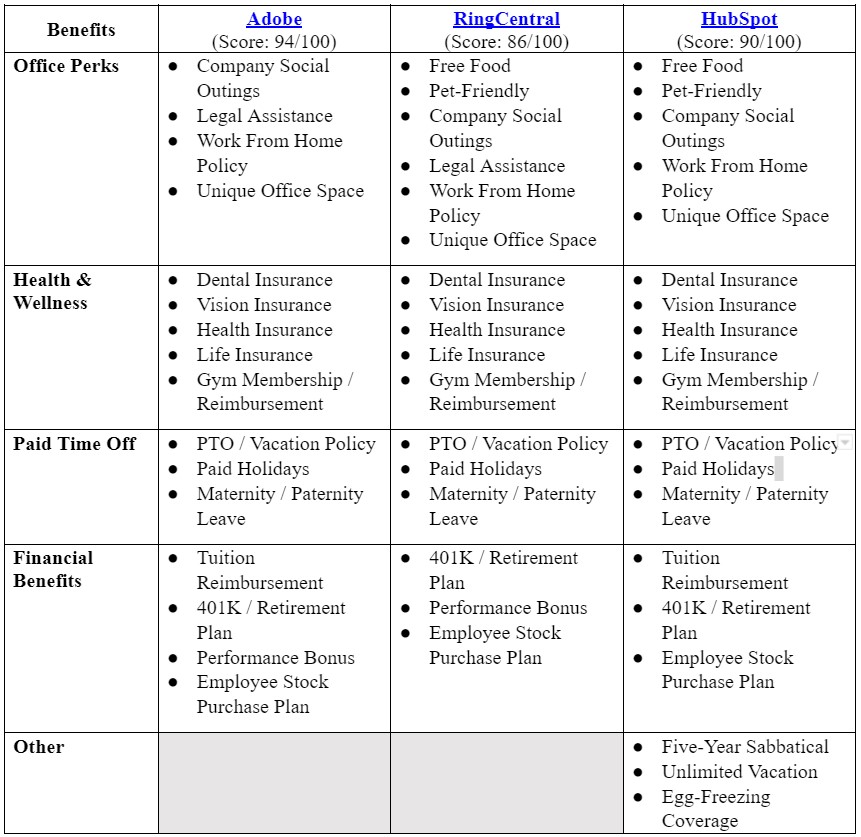
That’s a pretty impressive list of benefits they have there; no surprise they are in the top three of having the happiest employees!
As an employer, the best and simplest thing you can do to make your employees happy and love the company is to always ask for feedback. There are numerous aspects you’ll be able to uncover, such as what employees want more of, what should be changed, what new things should be added, and many others.
At the end of the day, remember that love works both ways. Employers can’t expect employees to love them if they don’t show love towards the workers, and vice versa (it’s a chicken and egg situation!). Then again, you could be doing everything possible, but some employees are simply impossible to please. That’s perfectly fine because no one is perfect, and the important thing is that you gave it your all!

Employee turnover is a major source of concern for many businesses because it threatens their reputation, productivity, and performance. While different companies may describe and categorise employee turnover differently, the Cambridge Dictionary defines it as “the rate at which employees leave a company and are replaced by new employees.”
Turnover can generally be classified into two types:
There could be a variety of factors why employees may leave departments or organisations, including burnout, a negative work environment, lack of growth opportunities, a competitive offer, and negative feelings towards management.
It has since been discovered that the most common reason for employees leaving their jobs is due to a toxic work environment. According to the Society for Human Resource Management’s report, ‘The High Cost of Toxic Workplace Culture‘, 58% of employees who quit blamed their managers, and the turnover had also cost U.S employers more than $223 billion!
To gain a deeper understanding of this crucial problem that’s causing employee turnover, let’s take a closer look at toxic workplace issues and what can be done to create a better workplace.
Toxic workplaces are marked by incompetent leadership, poor management skills, a weak rule of ethics, and poor communication. If these disruptions occur regularly, they could have a detrimental impact on both your physical and mental health.

A study of the UK workforce discovered that toxic cultures caused employees to be less engaged with their jobs, to suffer from anxiety as a direct result of workplace bullying, to seek therapy as a result of an issue they encountered at work, and to call in sick as a result of problematic behaviour they witnessed/experienced at work, among other things.
This is proof that when your job, your working environment, and the people you work with are all negative and distressing, they can begin to affect your life and lead to emotional exhaustion.
Moreover, according to Jeffrey Pfeffer, a professor of organisational behaviour at Stanford Graduate School of Business, the link between poor health and poor workplace conditions is “significant, profound, and has been documented over decades.” He also believes it’s a major health crisis, resulting in 120,000 extra deaths in the United States each year!
The hostile workplace and toxic culture will also result in low morale, conflict, negative outcomes, low productivity, inappropriate behaviour, unfair treatment, severe tension, and high turnover among employees. That being said, numerous situations can arise, causing employees to leave in search of a better opportunity.
There are plenty of examples of toxic workplace culture, ranging from office rumours and cliques, to misinformation and poor management. Be it managers, co-workers, and low-level employees, they all have the potential to create that unpleasant working environment.
To see if you’re dealing with toxic work issues, check out the following dysfunctional scenarios.

No matter what you do, whether it’s right or wrong, your boss will always find a way to negatively criticise you, making you feel down the majority of the time at work. To top it off, when he asks you to redo something or is dissatisfied with your work, he screams his lungs out at you until everyone outside his room can hear him.

You were never given a proper job description when you started, so you always do what’s expected of you. Then, without realising it, you have multiple superiors telling you to do this and that, and you end up with so many tasks that aren’t a priority or even related to your job role.

You did your best to finish and complete all tasks assigned to you, but you received no response after submitting your work. Worse, you only get negative feedback, and are asked to do the work again without any proper instructions. So, you end up figuring everything out on your own, and when you finally get it right, you get no credit at all.

There are employees of various ages and seniority levels in every workplace, but it becomes an issue when you constantly have to back down and give in to those who are older and/or have higher seniority than you. A junior executive employee shared, “Even though my senior executive is new and still needs to learn about what’s going on at the company, we can never agree on what’s best because the senior always feels like she’s in charge of EVERYTHING!”

The management or human resources department never provided a clear career path or opportunities for employees to advance up the ladder. Everyone is just doing the same thing over and over again, and no one is being sent to training to become better or to improve themselves.

No one knows the exact ratio for good work-life balance, but you’ll know it’s a problem when it begins to affect your health, relationships, and social connections. Some bosses believe that employees must answer to them at all times, even after office hours and on weekends/public holidays, especially now that some employees are working from home.

Everywhere you go in the office, you’ll hear people talking about other employees, departments, management, and even you. You’re also worried about offending anyone or saying anything inappropriate because anyone in the office could start snitching on you to the bosses behind your back. Simply put, no one in the office can be trusted.

Employees can’t do their jobs properly if their bosses are giving them contradictory orders that are never in sync. For example, you’re supposed to be working on a company brochure but got different instructions from the marketing director, the content lead, and the CEO. When something went wrong, everyone started blaming and pointing fingers at you for creating the brochure incorrectly.

When people only want to work with those close to them and refuse to collaborate with others who are not on the same page, the working environment has become toxic. You’ll notice certain cliques or groups at work who will only hang out with each other during office hours and even after work.

The company implemented a few toxic workplace policies that appear to be overly strict and outdated, such as a strict dress code, non-flexible working hours, stringent medical leave policies, and making side jobs illegal. This can create a toxic environment by making employees feel unproductive and non-compliant.
Every employee enjoys working in an environment that inspires and motivates them to achieve their full potential. Regrettably, this isn’t always the case. The list below will help you identify the different signs of a toxic workplace environment:
Every individual is accountable for improving the workplace so that everyone can work effectively and in harmony. However, as the people in charge of all employees, the HR department and managers must figure out how to prevent and resolve the toxic workplace culture.
Here are a few strategies that could assist organisations in dealing with hostile work conditions and, as a result, reduce high turnover rates:

Although there are various reasons to why employees may choose to leave their jobs, most companies are concerned when turnover becomes excessive and uncontrollable. High employee turnover can be costly and harm the company, including productivity loss, training new employees, added recruitment expenses, and revenue loss.
To mitigate this issue, employers must first understand the causes of employee turnover before making the required changes to keep the employees satisfied and happy. It’s crucial to evaluate all elements and investigate the reasons for voluntary and involuntary turnover when determining the targeted turnover rate.
Although toxic workplace issues are the leading cause of employee turnover, these issues can be mitigated and avoided by listening to employees and learning why they choose to leave or stay. Conduct a survey, individual interviews, or feedback sessions to discover more about what’s going on in the company.
Only then, the company will be able to figure out how to nip employee turnover in the bud before it becomes a severe problem!

As soon as you enter the workforce (no matter if it’s part time or full), you definitely would have heard about ‘HR’ and what it means. But, what about people management? This term is actually incredibly important to have in any healthy and successful workplace, as it involves the skill to oversee smooth and efficient workflow, in addition to boosting employee performance every day.
It’s no secret that people management is one of the most important skills a company can have. A subcategory of Human Resource Management (HRM), people management is basically the process of recruiting, training, optimising, and retaining employees to showcase their talents for the success of the company.
It can actually be much more than that! On the surface, it may seem like it’s all about leading the employees, but this can also mean caring for them, helping them overcome any issues, and pointing them towards excellence with their work – be it for professional or personal goals.
People management also births out the soft skills needed for HR teams to learn and use, in order to guide employees to their best possible performances. As this key aspect includes more expertise, we’re here to help you understand it better.
Keeping the earlier defined meaning in mind, we now know that the function of people management is pretty crucial. To manage a team efficiently, a people-oriented manager needs to have a specific set of skills to promote proper management.
It also does no wrong to identify if you’re in a healthy working environment, or if you as a manager are lacking in these skills we’re about to discuss:

Now more than ever, the questions “Are you okay?” and “Do you want to talk about it?” hold a significantly deeper meaning. Since 2020, the Covid-19 pandemic has caused an uproar in people’s levels of anxiety and insecurity when it comes to working. Having empathy will help keep employee productivity high when you try to listen to them, making them feel heard and by understanding matters from their perspective.
There’s just something about a manager who’s accountable, honest, and takes action with the aim of correcting a wrong with no other hidden agenda. An employee will always want a leader who not only does the right thing, but also someone who is not biased.
Communication is such a wide term with many definitions. This is why it can get lost in translation at times. As a manager, your communication skills should include (and not only be limited to) listening via verbal communication, but also via non-verbal communication like writing and through public speaking scenarios. Bear in mind that good communication is what defines a successful and failed relationship between an employee and manager.
Great leaders often empower others. When you mentor an employee, you give them the reassurance that they can achieve higher goals as well as better themselves within and outside company grounds.
When half the population is still working from home, it makes it difficult to engage and motivate the staff in a positive manner. With the ‘new pandemic normal’, persuading your employees to be more enthusiastic is not an ideal setting. So, how can you help them?
It really all comes down to what your employee truly desires during these moments. Once you get the gist of it for e.g. if they want to reduce workload, have more responsibility, be paid more, or just simply to be appreciated, it’s your job to motivate them to that desired direction. Simply engage with each person to find out what it makes them ‘tick’ and how to make it happen.
If we were talking about pre-pandemic days, encouraging people would have just meant having an office party or team-building exercises. But as we’re stuck in unprecedented times, it’s hard not to think out of the box. This is where a silver lining to the issue comes in.
As we move into the third year of the pandemic, it has become easier to tap into the ‘new normal’ (learning on the fly does have its benefits!) and establish a good bond with the people you work with. So, how do leaders and HR actually help to encourage that fact?

Well, the first task here is to keep their people up-to-date, be reassuring and build trust. HR personnel’s have to convey messages that are still empathetic, in order to build trust with the employees who are now placed under these different and difficult work settings. They can help to distinguish and prioritise what matters to focus on, and how to safeguard the culture for now.
Another good tip for leaders is to engage their workers in quick surveys and engaging feedback that can provide the HR team valuable insights to narrow down on the decision to check in, motivate or keep people on board. Having a therapist during these sessions can also help calm any tensions in addition to providing a safer environment.
It’s simple. When you begin to invest in your employees with the intention to empower them, they too will begin to give back to the company with renewed vigour, great feedback, and a better sense of purpose.
When you strategically begin to care for the needs of your employees, positive progression takes place – hinting that they are seen and heard. This will birth a thriving new company culture among all.
It’s a new way to move forward. While the traditional methods of HR strategy and workforce planning do not meet the current needs, it’s time to consider a new approach – one that is fresh and adaptive, with room for changes as the years go by.
You would have to curate a humanising employee experience, one that focuses on them being able to do the job that they truly desire. It’s a known fact that happy employees are more likely to stay at a company that respects their wishes and demands, plus understands where they shine best. By promoting their ever-growing success, managers will be able to boost morale, loyalty and commitment among their employees.
It’s nice to think that this is the future we’re possibly looking at, right?
People management is the subcategory of Human Resources that oversees the process of training, development, motivation, and managing of their employees. A manager is usually in charge of the whole department.
The 5 c’s that are usually associated with this are clarity, context, consistency, courage, and ends with commitment.
Skills that every manager should have include: Being empathetic, showing leadership skills, communicating well with employees, is built on integrity and ethics, a key motivator, trustworthy, and someone who is knowledge-seeking.

A performance improvement plan (also known as ‘PIP’) consists of a legal document that contains all the issues that have come up in your conduct at work. The document also includes solutions or remedial steps towards these problems, so that you can correct them.
Now, most people view PIP as a negative sign because it usually signifies that a company is contemplating removing you from the job. This is the reason why every employee fears being put into one, and tends to lose all hope when met with one. But, there’s more to it than simply losing your job.
This article aims to clarify everything so that you’re able to know what to expect, and how to go about ‘graduating’ from it!
A performance improvement plan is often introduced by the HR/companiesas a measure to improve workplace productivity in the office. It’s also beneficial for companies to identify whether employees are facing any difficulty in meeting goals, or if they’re resorting to maladaptive/inappropriate behaviours. Because of its probationary nature, the PIP is often misunderstood as a corporate practice for layoffs.
Though this can sometimes lead to the termination of employees who do not contribute to the company’s cause, a PIP can be beneficial for management and employees alike. Such plans, for companies, are often an initiative to retain employees, while allowing them to improve their workplace productivity. It’s extremely helpful because it allows the company as well as the employees to evaluate performances that work against the company objectives, and clarifies what’s expected of an employee.

Instead of having your employees panic at the thought of a performance improvement plan, it’s a good idea to explain to them the importance and benefits of such a plan. With adequate support and information, your employees are less likely to think of this formal document as the worst and start collecting their stuff in anticipation of layoffs.
Rather, explaining to them what the plan stands for would give them a better perception. Encouraging your employees to accept a PIP as just another method of help can assist them in realising it as a second chance to get better at their job and improve productivity.
As a manager, it’s always beneficial to be there for your employees, and encourage them to sign. This is helpful in eliminating any confusion your employees might have regarding the procedure. It not only improves interpersonal relationships within the office, but is also indicative of how dedicated your employees are when it comes to executing the tasks mentioned in the plan.
The key is to exercise a positive attitude at all times so that your employees are not demotivated at the thought of signing the PIP. You can also recommend your employees to consult their peers in the office, and find out how they manage to complete all their tasks on time, as well as keep themselves motivated in a workplace environment. It boosts morale and is a good initiation for employees to learn about the benefits of this plan.

Before you proceed to draw one up, you must reconsider and think hard about whether it’s absolutely necessary. A lot of workplace issues can be solved by a simple one-to-one conversation with your employees. But, if you think that won’t suffice, then you may go through the following steps to establishing it:
When you hand out the formal document to your employee, you must be extremely clear about your terms and expectations. This is why you must include constructive solutions that the employee should implement to meet your expectations, so that they can work on those specific areas and improve.
You must handle the meeting with extreme care and tend to all the queries of the employee. While explaining the terms and conditions of the PIP, you should also keep in mind to remind the employee that they’re an important asset to the company, and that this plan is their chance to improve and continue being so.
Taking your employees through their PIP is not always sufficient. To yield better results, it’s also important to keep an eye on how your employees are progressing through each stage. Observing their progress and being there to help them tackle any problem they might face are effective ways of implementing the plan and ensuring employee performance improvement.
Once it’s completed within the stipulated time, you can consult the human resource manager to figure out if it was able to yield results that are on par with your expectations. Depending on the outcome, the employee must be made aware of the next course of decision.

The thought of signing for a performance improvement plan can make you uncomfortable and/or worried. However, such plans do not necessarily signify termination. So, there’s no immediate need to panic and prepare for the worst. Instead, having a positive attitude can help you get through with it, while retaining your job.
A motivated mindset can also be a sign that you’re appreciative of your employer’s suggestions, and are trying to improve your value as an employee. Taking responsibility for any previous imperfection is a mature way of progressing with the PIP. If you’re confused about the prospect of being in one, it’s important to get your doubts clarified by the manager or HR. Consulting with your peers is also helpful in progressing with the plan.
To get through this period of time, you can start by improving your efforts to accomplish the goals for the plan. Not only does this show your dedication, but it can also help you better grasp your responsibilities as an employee. You can also set your own goals as you improve in gradual stages. Checking in with your supervisor and consulting with your team can also provide you with valuable information to review your progress with the PIP.

A performance improvement plan fulfils its objective of showing good progress in those aspects where a particular employee was showing deficiency in. Moreover, if the plan fails to attain its purpose, then the company can easily let go of the employees who don’t contribute to the company’s cause, without having to fear a lawsuit.
The following sample will definitely help you to prepare a performance improvement plan, as per your requirements:

There is no specific time period for a PIP. It depends on the kind of tasks that have been included in it.
Not signing a PIP can have serious repercussions within a corporate framework and lead to inconveniences. If your employees are still having second thoughts about signing the plan, it is always a good idea to explain to them the benefits and reasons for it.
A PIP can be extended only if the reasons are very serious. For example, if certain information with respect to a task in the plan is not available at the moment, the HR may consider extending it.
Hearing about a performance improvement plan can result in negative thoughts in an employees’ mind. Usually, the most common response to this formal document among employees is panic. As a manager or HR, it’s important to be there for your employees in their times of need.
If your employee is going through a PIP, it’s important to reassure them how valuable they are for the company so that their work output is maintained while completing it. And, as an employee, consider it a chance to showcase your dedication towards the company and keep a positive attitude to train and develop yourself.

Most candidates tend to look beyond just the salary, benefits, and other materialistic offers when it comes to job finding. When looking for a new role, candidates do also take note of the working culture in the company.
More often than not, people will decide to join a company with a good working culture over the bad ones, as it’ll help them learn and grow professionally and personally in the long run.
So, what is a work culture exactly, and why is it important? Well, this aspect depends on the collection of attitudes, beliefs, and behaviours between everyone who works in that company, including the bosses. Healthy work cultures also include to what extent the company takes care of their employees’ well-being.
A good working culture ensures employees have work-life balance, growth opportunities, and job satisfaction, which will undoubtedly influence their attitude in a positive way. Aside from that, having a collaborative environment also helps your company in multiple ways, which include:

A positive work environment will attract candidates with positive attitudes. With an excellent track record, it’s only normal for you to have better hiring choices.
This will also positively impact how the employees interact with their work and company. A company with a great work culture will prevent high employee turnover.
The company’s working culture is often associated with its brand and reputation. If the organisation provides a great environment, undoubtedly, the public would assume that the company is great. And the employees speaking well of their work to family and friends will play a part in ensuring the company maintains its image.
Companies with greater working cultures often outperform those who don’t have any. Generally, the stronger the working culture that encourages its employees to go above and beyond, the more successful the company is.

A company must make sure that everyone is held responsible for their choices and behaviour. To do that, the workplace must play its part to ensure that all employees feel that they’re comfortable taking credit for both their ideas and mistakes. Not only does accountability fosters responsibility among all employees, but it also makes them team players that are trustworthy.
Having a healthy workplace culture means that the companies will do their best to treat all their employees equally. Let’s face it, every position starting from the lowest to the highest level, has its value and role to play in that organisation.
However, favouritism and misuse of power often happen in an organisation, which may cause feelings of resentment and distrusts between co-workers. When such toxic cultures exist in a company, it’s only natural that all the employees working there will have low morale.
More often than not, when employees are able to express their thoughts, opinions, or even dissatisfaction freely in a company, they’re generally happier. And if employees are given the freedom of style to a certain level to decorate their workspace, it’ll make them feel more comfortable and less anxious to come into work in that company.
Communication is recognised as one of the most crucial factors to a healthier working environment. Everyone within the company must learn the respectful ways to give and receive feedback to avoid interpersonal conflicts. Functional work culture will allow everyone to resolve issues by sharing ideas and collaboration, regardless of their roles in the company.
The higher management in the workplace must ensure that their employees’ successes are well-recognised and rewarded, instead of discrediting them by saying, “You’re just doing your job.” A healthy workplace environment will acknowledge their employees’ positive traits and attributes, as well as encourage them to polish their talents. How can you do that? Simple praise of their good work would be sufficient; but if you’re going for more, giving them a competitive salary and also helping to build a culture of appreciation and mutual respect among your employees would be good steps to take.

We now come to the good part! The first step you need to take to build a better work culture for your company is to know your company’s core values. It’s vital for you to ensure that everyone understands and are aligned with your company’s core values.
Why? Because these will act as the fundamental values in building the work culture of your dreams. So, here are the eight best practices to achieve a healthier working culture:
Each team should have their objectives and goals outlined in a clear and precise manner. Working towards a common goal will help increase their individual performances, but it will also promote teamwork between the members in that particular department.
A diverse mix of voices often leads to a better discussion, decision, and outcome for everyone in your company. A positive and inclusive working culture will encourage employees to speak of their different perspectives, which are valuable for solving problems. An initiative to promote diversity and inclusivity in a company will also help employees feel more comfortable at work by simply being themselves. These fundamental elements of diversity and inclusion will definitely help grow your organisation.
A company should ensure that each and every individual feels valued and their voices heard, regardless of their culture, status, or background within and outside of the company. Why? Just because a person doesn’t have enough experience or comes from a different expertise doesn’t mean they wouldn’t have ideas to help solve your problems. Based on our past experiences, you’ll be surprised just how many times the fresh perspective of an intern may offer you a more significant advantage in resolving your company’s issues.
As mentioned before, employees should not be discredited, and instead, they should be recognised and rewarded for their outstanding results. Having a recognition program will make your employees feel that their company values them. As a result, they’ll feel encouraged to strive for success, which motivates them to take it to the next level when working in your organisation.

When your employees provide their perspectives and feedback, don’t turn them away. Instead, try taking what they have to say into consideration and see where their feedback is coming from. Sometimes, a bottom-up approach may be more helpful than a top-down approach when identifying problems. More often than not, employees experience first-hand operating issues when they’re working on their tasks. Instead of thinking of their feedback as an indication that you’re wrong, see it as an opportunity to evolve to help better your organisation.
Transparency and open communication between the higher management and staff will help build the trust needed to succeed. Instead of feeling unheard and unvalued, which may result in conflict, creating a more open culture will help boost your employee’s overall morale.
Sometimes, an immediate response is needed when things go south. Your employees shouldn’t fear repercussions for deciding on solutions for the troubles at hand. Employees also shouldn’t be punished for taking some time off to manage other emergencies or personal responsibilities outside of their work lives. By giving them the time and autonomy to do certain things for a reasonable cause, they’ll most likely be more grateful, respectful, and loyal towards your company.
A healthy working environment includes creating an opportunity for your employees to be active and get to know each other better. Having social outings, gatherings, and functions will help foster meaningful relationships at work. To a certain extent, these social events will help foster mutual trust and respect among the employees.

Although providing lunch breaks are not legally required by the law, taking away the rest time of your employees, which you promised them upon hiring, will definitely stress them out. Remember, your employees are humans, and not machines that can work for eight hours straight without nourishment and still be expected to be healthy.
Aside from their working life, your employees probably have some personal matters they need to attend to after work. So, avoid meeting, texting, or emailing your staff after working hours, unless it’s an urgent matter. Even then, if they say no, try not to hold them accountable for not attending to the emergency after their working hours.
Limiting the opportunities for your employees to learn will not only result in a loss for them, but also for you. Allowing your employees to pursue their passions outside of their job description will encourage the sharing culture between colleagues. As a result, not only will your employees have better relationships with each other, they’re also more efficient, and could even bring their newfound skills to help better your organisation.
As an employer, you shouldn’t tolerate managers who abuse their power even if they managed to push your company’s productivity to a higher level. “But if it works, why should I not tolerate it?” Well, even if your productivity managed to increase by a significant number, having poor managers who aren’t compassionate to their staff will only cause your company to have a high turnover rate, which is more costly in the long run.
Although creating a healthy work culture seems to fall under the HR’s jurisdiction, the truth is, a handful of people can only do so much to create a good working environment. Positive cultures are created when everyone works together. Leaving it up to HR alone will probably make things worse, and sometimes, this is a task that requires the collective efforts of everyone.
As the saying goes, “Do unto others as you would have them do unto you” – which means that if you like working in a positive, fulfilling environment where your hard work is noticed and rewarded… make sure you create the same kind of work culture for your employees. They’ll thank you for it, and strive to greater heights!